Showing posts with label art. Show all posts

Saturday, March 19, 2016

Strokes And Carvings

Welcome to my DIY gallery, works by a largely untotured artist punching his way through arts and crafts! Although I tried my hand at painting in the late Seventies I stopped for awhile and now find myself creating pieces just for fun, which is a nice way of saying I've become more of a hobby painter. The serious art days are far behind me, and that's alright. I like being a Sunday painter.

One of my favorite subjects is glam rock, so painting Seventies style hard rock stars rockin' out makes me happy. Right up above is a favorite of mine. It's a dramatic portrait of my man Desi rocking out some righteous metal a la Poison, Great White, etc. with his band Whiskey Starr circa 1988 at White Trash A Go Go, maybe English Acid, prob not Zombie Zoo.

In front of the stage is his rich Jewish American Princess girlfriend wearing the official band tee getting pissed off at some cheap poodle-haired blonde who's been shaking her shoulders to Desi rocking out. I don't know about you, but I think a catfight is imminent.

Or how about a painting of Iggy based on one of the photos in back of the Raw Power album? I liked doing this one, and took great care in rendering a stylized look to his crazy eyes and lipsticked mouth. I really invested as much glam realness to the image as possible.

At this point it should be pointed out that when I first painted I used oils, giving everything a rough, expressionist look. I used a lot of heavy black lines and really slathered on the paints. It was a really violent look, however, later on when I got back in the game I used acrylics for a smoother, more refined look.

Getting tired of paints, I tried my hand at woodcuts because I liked the raw, violent look it gave, so here's yet another picture of Desi rocking out on stage with a smoke impudently dangling from his lips. I printed it with black ink on colored paper. I thought it turned out rather well.

Here's another woodcut I call King Cactus, showing a very tall, happy cactus rejoicing in his native habitat. I always liked the way large cacti always had long arms reaching out for you, and this guy seems to be having himself a good time in the wild.

Pictured below is Payin' The Bill, a painting of Desi offstge enjoying margaritas and some taco combination plates with the his rich girlfriend paying the bill for her very kept boyfriend. Where are these girls??? I need to find me one, but that's another blog.

Saturday, August 23, 2014

Halloween In August

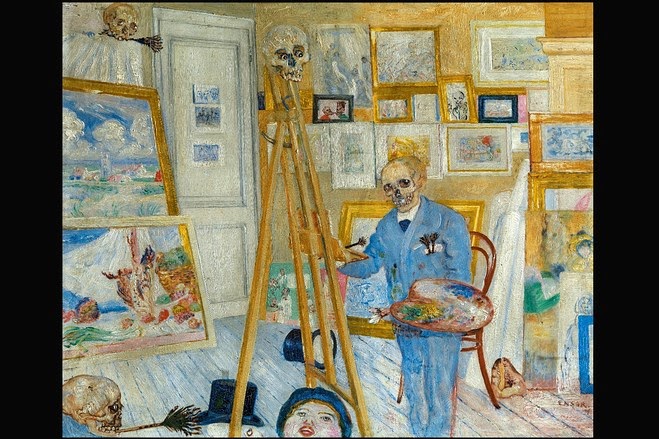
In the early Seventies when I lived in New York I bought a litho of a creepy painting titled "Masks Fighting For The Body of a Hanged Man" by an artist named James Ensor. Pictured above, it's an illustrations of two skeleton women literally fighting it out with brooms and mops over a hanged man with groups of masked freaks and witches looking on from a doorway. It was unlike anything I had ever seen, and it was my entryway into the art of James Ensor.

James Ensor, born in Belgium and creative during the turn of the century , may be one of the most under documented artists ever known. His artwork is an endlessly creative line of grotesque images rendered in a naive art style that can truly elude any easy classification. Sometimes impressionistic, other times expressionistic, yet neither, perhaps his inability to be classified explains his regrettable obscurity after all these years, almost 100 years after his death.

All this "regrettable obscurity" came to a close one afternoon this summer when I drove down Pico Boulevard and saw huge banners of Ensor art hanging from street lamps announcing The Getty Center exhibiting a show called "The Scandalous Art of James Ensor" (June 10-September 7). I could hardly believe my bloodshot eyes!

The Getty Center show is truly a feast to the eyes of any Ensor fan, providing an absolutely comprehensive retrospective this side of Brussels of the great artist's works. I also learned a lot about the great man himself, and was surprised by what I learned. Mr. Ensor may have been The Original Goth Kid. A portrait of his maternal grandmother informs us that she was a seller of grotesque masks which excited and influenced his art in the years to come.

He was also a big fan of Edgar Allen Poe's works and his paintings based on several of his stories, i.e. Hop Frog, including the bizarre "King Pest" were on display at the Getty. He also had a cool harmonium (Nico's keyboard of choice) in his studio that he enjoyed playing. This dude was Goth before Goth got cool!

For all the horror business Ensor served up I don't think it was all gloom and doom. I detected notes of humor in many of his works, and his depiction of government and military officials were reminiscent of George Grosz in the cartoonishness (Ensor predated Grosz so it's presumptuous to say he was an influence on the German expressionist). The subject of death breached a cross between humor and horror, and I liked the party and horror mask paintings the most.

Ensor's wild masterpiece "The Entry of Christ Into Brussels" (1888) was not only displayed in its full splendor but also had a little magnifying glass-style display you could peruse all the details of this unique masterwork. Ensor's mixture of colors and even brush strokes were so erratic which left disturbing hints of a runaway psyche on every piece displayed.

I was happy to see so many people analyzing and enjoying Ensor's works - attendance was pretty robust for such an obscure art star. I also chuckled when I saw an endless line of Ensor souvenirs on sale at the sale counter. I wasn't ready for an Ensor coffee mug, but I got a few magnets and punk rock-style buttons. Now maybe Taschen can put their Ensor retrospective back in print!

Thursday, October 25, 2012

Happy Birthday Jim Steranko

This year’s annual Scorpio birthday tribute goes out to comics legend Jim Steranko. Along with Neal Adams, Steranko brought a maturity to comics in the late Sixties that completely changed the way people saw comic books, Adams with DC’s Deadman in Strange Adventures comics and Steranko in Marvel’s Nick Fury, Agent of S.H.I.E.L.D. Jim Steranko brought graphic style in a medium that was still mostly stuck in exaggerated, cartoony caricatures. Steranko’s art style brought comics into the Swinging Sixties, incorporating elements of Pop Art, colorful psychedelia, and cinematic images mostly influenced by Mario Bava films (ref. Black Sabbath, Danger: Diabolik, Blood and Black Lace, etc.).

A Jim Steranko comic book cover leapt off the stands every month; no other comic on the newsstand even looked like his or even came close. Steranko’s first work for Marvel was Nick Fury, Agent of S.H.I.E.L.D., a poor cash-in on the James Bond spy movie craze featuring a post-war Sgt. Fury with a few of his Howling Commandos on board (Dum Dum Dugan and Gabe Jones). The series was barely breathing oxygen providing support to the superior Doctor Strange in Strange Tales Comics. Steranko originally drew layouts for Jack Kirby in the series but eventually took over the art reins, then taking over the writing reins from Stan Lee and Roy Thomas, gaining complete control over the series and taking it places not seen in comics at the time.

One of the best examples of Steranko’s graphic genius is the legendary cover to Agent of S.H.I.E.L.D. #4, often imitated to the point of even The Simpsons comics doing a tribute to the cover. In addition to Agent of S.H.I.E.L.D., Steranko blew minds with his work on Captain America, X-Men, and a cover for The Incredible Hulk that has to be seen to be believed!

A new Steranko comic release in 1967-68 was as eagerly anticipated as a new Beatles single, in that it heralded an exciting new way of seeing things. A lot of other kids must have agreed with me because they were some of the fastest selling comics to fly off the stands. It took me years to score Agent of S.H.I.E.L.D. #1 because it instantly sold out on release.

Jim Steranko, born November 5, 1938 in Reading, Pennsylvania, grew up working in carnivals as a fire-eater, magician, and later resorted to burglary. He also got heavily into playing guitar in various local bands. After a period of commercial art, Steranko moved over to illustrating several short-lived superhero series for Harvey Comics.

Steranko’s legendary work for Marvel gave him artistic control that included splash pages in the middle and end of the comic, sometimes even taking up two pages, unheard of at the time. He also colored his own comics, a first at the time. All this artistic freedom eventually came to a head when Marvel big kahuna Stan Lee began heavily editing Steranko’s previously untampered work,creating major friction between the two men.

Steranko’s next move was to start his own publishing company Supergraphics, which produced the Steranko History of Comics in 1972, one of the earliest academic studies on the history of comics. By the 1980’s he published Prevue Magazine, an aggressively heterosexual movie magazine that always managed to plug in a few photos of Sybil Danning and Steranko clutching some hot, new young blonde action movie starlet.

Jim Steranko was inducted to the Will Eisner Hall of Fame in 2006, and continues to this day to be a major influence in comics art. Like a Sam Fuller film, Henry Moore sculpture, or Captain Beefheart album, once you’ve seen a Jim Steranko comic you know you’ve seen something incomparable and unforgettable.

Wednesday, September 19, 2012

Happy New Year 5773

At this time of year the Jewish Holiday Season begins, inaugurated by the Jewish New Year, which is now 5773. Around this time I engage in thoughts both religious and secular, but as long as I’m discussing religion I want to talk about my favorite artist, Marc Chagall. The majority of Chagall’s timeless artwork is Jewish-based, mostly reflecting the streets of the European ghettos of the 19th and early 20th centuries.

Chagall’s art style strikes an equal balance of fauvism, surrealism and naïve art that still presents a challenge to the viewer. The presence of animals in his painting, such as goats, chickens and cows is not necessarily intended for comic relief but is included because many homes in the pre-war shtetls (Jewish villages) had farms which housed these animals.

Most religious art is bound by tradition but Chagall’s depiction of religion is the freest ever painted, unencumbered by any pressure to follow reverence. While it isn’t irreverent by any means, there is a playfulness and humor that is absent in most religious work.

Whenever Rosh Hashanah (New Year) and its successive holidays come around I always look at my Chagall books and enjoy the works of a brilliant genius. His work transcends the folklore of any religion - if you’ve got eyes you gotta feel it.

+++++++++++++++++++++

I live in the heart of the Jewish hood on La Brea Avenue between a girls’ school and a wig store (heh!) and the school kids walk by under my 2nd floor window. It’s funny when I play my techno-swing records because a lot of them use clarinet, giving the music an almost klezmer-type sound. One day I was blasting out “Chambermaid Swing” by Parov Stelar, the lord high fixer of electro-swing, and I could hear a bunch of school kids hooping and hollering outside my window.

The Mojo Radio Gang - Parov Stelar

Who knew Jewish kids were into this Betty Boop swing shit? But it all fits, the music, the era, the culture, a lot of it has very Jewish roots (Afro too, of course, but this is really Jewish sounding stuff!). Just to make sure I wasn’t imagining things I played “The Mojo Radio Gang” by Stelar and I could still hear those crazy kids outside enjoying the music.

Princess Crocdile - Gry

After doing a little bit of research I discovered that electro-swing is pretty big in Europe, esp. in Britain and Germany, where they even have gigantic festivals dedicated to this hypnotic, insane dance music. Girls dress like Louise Brooks/Clara Bow flapperdoodle and guys look like old bootleggers, and it might all dress-up , but it doesn’t matter. The king of swing Parov Stelar looks like a male model so you don’t need to re-enact “The Sting”.

Chambermaid Swing - Parov Stelar

Just to raise the Betty Boop stakes some more I played “Princess Crocodile” by Gry, a bizarre ballad about a woman who travels through graveyards as a swing band of ghosts vamp on "Sweet Georgia Brown". By the way, the kids didn’t leave until I stopped playing all that crazy electro-swing. Never mind the lame American punk revival, electro-swing is the very next craze. The kids have spoken. Loudly!

Thursday, April 12, 2012

Bill & Peggy & Rudi & Camille & Track Lighting

One of the most infamous mixed media ménage-a-trois collaborations of the past fifty years was the brilliant work by jazz photographer William Claxton, his wife/model Peggy Moffitt, and genius designer Rudi Gernreich. Their work together has been documented well through the decades, notably in “The Rudi Gernreich Book”, edited by Claxton and Moffitt and also in Claxton’s short film “Basic Black”. So it was absolutely thrilling to attend the mixed media presentation of their work titled “The Total Look” at West Hollywood’s Museum of Contemporary Art (MOCA) at the Pacific Design Center.

The show had something for everyone: fashion, photography and dance: Moffitt started out as a dancer, and struck many modern dance poses in her modeling. It was the ultimate mixed media presentation; the ground floor had “Basic Black” playing on one screen with a slide show playing Claxton photos of Moffitt decked out in Rudi’s stunning designs on the other. On the upper floor were original and replicas of Gernreich designs dressed up in mannequins around the room. Seeing his mod fashions in the flesh complimented the great Claxton fashion photography that framed the walls around the room.

All three worked in perfect synthesis with each other, with Claxton’s photography capturing Moffitt’s expressiveness lending elasticity and shape to even the most abstract outfits designed by Gernreich. While Gernreich’s designs were amazing and dynamic enough to be modeled by any top model of their day, Peggy Moffitt added an extra dimension to his more geometric designs by ramping up the angularity in her dance poses.

Genreich’s designs have an almost architectural quality to them: cone shaped helmets, the infamous topless bathing suit, mask-like hats that cover half the face; some of them can be viewed in the modeling scene in “Blow Up”, along with Ms. Moffitt herself. He was the ultimate designer, endlessly inventive with shapes, patterns, and printed fabrics. The ingenuity of his designs displayed in the upper showroom were rich in color, composition and shape, a true inspiration for anyone even remotely interested in fashion design. I will definitely return to “The Total Look” before it closes in late May.

+++++++++++++++++++++++++++++++++++++++

Camille Rose Garcia had an exhibition at the Michael Kohn Gallery to mark the release of her remarkable interpretation of the Grimm Brothers’ fairy tale, “Snow White” (out now via Harper Design Books). The acrylic paintings were strikingly colorful and rendered in her inimitable style, vertical cascades of color running down the pieces like unholy stalactites in a Technicolor cave.

Her rendition of the legendary characters was priceless: The Seven Dwarfs looked like a cross between E.C. Segar’s Jeep and a pack of hairless possums. Even Snow White looked kind of out of it in these pieces; the exhibit had a nightmarish, otherworldly quality. The Prince who saves Snow White is rendered by Garcia as some kind of bizarre-looking gigolo. I liked the part where she’s poisoned in her bed with her name written on it like some kind of coffin.

I haven’t seen her book on Alice In Wonderland, but all the same I highly recommend “Snow White”. As long as she’s doing Disney remixes, maybe Cinderella or Sleeping Beauty will be next.

BTW, Michael Kohn Gallery, you might want to check what year you're living in before you print up posters. I mean really.

Thursday, November 24, 2011

Tramping The Galleries

Saying that the Autumn 2011 season on the gallery scene is the hottest in years would be an outrageous understatement. There’s something for everybody: “Pacific Standard Time”, the most sprawling retrospective of Modern Art In Los Angeles, dozens of photography shows featuring the most outrageous American shutterbugs, and even some wild lowbrow favorites. If it wasn’t happening at the movies or in the nightclubs it was definitely popping in the galleries!

Late October set the stage for the opening of the Ellen Von Unwerth show at the Fahey/Klein Gallery on trendy La Brea Avenue. Her new show coincided with the release of her new Taschen book, “Fraulein” ($500 – cheap?). The pieces featured were black and white - no color shots this time, and looked like some kind of Louise Brooks porn shoot complete with “Story of O” masks, making the models look like off-duty steampunk superheroines getting into sexual mischief. In the smaller room was the incredibly awesome fashion surrealism of Melvin Skolsky, showcasing his “Paris 1963” work. Skolsky is the photog who shot those insane “Model In A Bubble” in the streets of Paris series. The limited edition book was on sale there, also. One of the best Fahey/Klein shows I’ve been to.

Mid-November got even crazier starting with Travis Louie’s “Curious Pets” show at the Merry Karnowsky Gallery. The pieces were black and gray acrylic portraits with static white backgrounds fabricating the illusion of old turn of the century engraved photographs, but naturally with a wicked twist. Pieces included “Martin and His Bat”, a young man with a vampire bat sitting on top of his head. Then there’s “Agatha and Her Beetle”, a frail, anemic lass with a big, gnarly beetle resting in her wiry hair. Each piece was accompanied with a short fable telling a tale of these folks and their strange pets.

Pictured above is "Uncle Six Eyes", a great resin bust created in two versions: a white version and a black version. It's a great parody of the Ludwig Van Beethoven bust that was de rigeur in every home during the 1950s and 1960s. Overall the style of the pieces in the show was like an ungodly union between Mark Ryden and Basil Wolverton. By the way, a quick scan of the upcoming show schedule at Karnowsky’s gallery shows every indication that she will be the mid-city lowbrow capitol of Los Angeles.

Getting back to photography I saw the Hedi Slimane show, “California Song” at the Museum of Contemporary Art (MOCA) at the Pacific Design Center. Slimane’s right up there with Von Unwerth, Richardson and LaChapelle in the new breed of crazy fashion shooters that’s burning up the editorial fashion magazines internationally. The show appealed to my deadpan sense of humor: on the ground floor his photographs (all black & white) were on display, all unlabelled and mounted on drab wooden crates, as one-dimensional as you can possibly get.

Upstairs was another matter entirely: slides of the very same shots and more were projected on a three-sided wall over 10 feet tall, creating a much more satisfying and, dare I say it, moving experience. It sort of makes you question the whole gallery system in one fell swoop. There were enough showbiz photos to keep you happy (John Lydon smoking, a rotting Brian Wilson, and LOTS of Michael Pitt, maybe too much), but the best shots of all, ironically, were his surfing photos.

That’s ultimately a true testament to the brilliance of Slimane’s artistic eye. Taking exciting surfing pictures makes you a good photographer, but shooting awesome ones in BLACK & WHITE makes you a GENIUS.

Friday, September 9, 2011

Rip, Rig and Panic


Back in the Pleistocene era of punk rock (1977-1979) the top fanzines of the West Coast were Slash (Los Angeles) and Search & Destroy (San Francisco), which were both written and designed by people that worked in the field of graphic arts, cinema and publishing. This meant that both fanzines not only covered the new music that was emerging at the time, but also covered cutting edge artists, filmmakers and performance artists. Performance artists got an extraordinary amount of coverage in Slash/Search & Destroy, and a lot of these artists were every bit as exciting as any punk band.

In an era of Siouxise Sioux, The Slits, and Cindy Sherman, no other artist embodied femininity gone awry better than Johanna Went. Playing every feminine role with the manic ferocity of a mental patient, Went portrayed nuns bathed in blood carrying crucifixes, violent housekeepers throwing flour around the stage with baby dolls tied around her neck, speaking in tongues, babbling and shrieking into a microphone. A terrific jazz-noise combo would punctuate her whirling dervishes, creating an aural wallpaper as disturbing as her I Am Woman nightmarisms. She even released a great EP of jazz-noise bludgeon called “Hyena” (available on eMusic with bonus tracks, yes!).


If there was a British Music Hall act from Hell it would be The Kipper Kids. Two stocky men who favored a cross between British lorry drivers and The Blue Meanies from “Yellow Submarine”, a performance from them would include: a boxing match between them clad only in jock straps – who would you root for, Harry Kipper or Harry Kipper?, a version of The Velvet Underground’s “Heroin” on ukulele, or an argument between them in a language only they knew. And of course, a lot of blood, animal entrails, food product and fluids all over each other, which is the sort of “Johnny B. Goode” or “New York, New York” of the performance art world. No performance artist could complete their show without making a mess all over themselves.

But performance art was more than just a spectator sport. When I lived at The Masque (1978) I once woke up to the sounds of metal being banged around, kind of like a garbage can fighting its way out of an alley. When I got up to see what the racket was all about I saw Z’ev auditioning on stage, which meant him hurling a gauntlet of metal cans, pots and scrap metal all tied together and creating a cacophonous metallic soundscape. I thought he was great, but I wanted to jam, so I busted out my saxophone and walked into the hall blowing some wicked atonal tenor saxophone. Z’ev looked shocked and probably a little pissed that I was playing along, but Brendan Mullen and company were entertained by my contributions.


Word got around The Canterbury (where I lived after the Masque) that Hermann Nitsch was doing his“Orgien Mysterien Theater” (trans: Theatre of Orgies and Mysteries) at The Otis Institute of Art and if you had a horn you were invited to play. My neighbors Don Bolles of The Germs and Pat Delaney of The Deadbeats were going but I couldn’t make it, and I was bummed. The day after the performance Pat had dried blood all over him, and he said I missed a great show. Naked men and women were tied to crucifixes behind hacked animal carcasses as Nitsch poured blood and cow entrails all over them while the horn players blew a wall of noise. I kicked myself all week for missing that one!

Another phenomenon that was fairly big at the time was tons and tons of loft parties in the warehouse district in Downtown LA where all you had to do was show up with your horn and blow. Sometimes with a band, sometimes just by yourself along to prepared tapes, it was important for the maximum effect of the loft party. Nobody played crummy rap records, it was all about the originality of the environment and even if youdidn’t know the host of the party you were welcome to play. Shit done changed after all these years. People need to loosen up!

At the risk of writing yet another whiny piece about how cool the scene used to be I just want to testify that there was a time when punk rock was more than just a lot of bands and party merchandise. It was a living, breathing wall of sound and vision, and I’ll always fondly remember those days of watching, listening, and even participating in the sonic outrage of the Seventies.

Wednesday, February 9, 2011

Neon Park: Grandaddy of Lowbrow


If anyone painted lowbrow art before there was a name for it then it was the late, great Neon Park aka Martin Muller, a former poster artist for The Family Dog. As early as 1970 he was producing some of the most memorable images in rock music. Here's just a small sampling of his great work, indelibly scarred into my subconscious:


Yeah, I hate Little Feat, too, but who can forget that awesome album cover. Constance Bennett with an accordion? Insane! The great thing about his work is that it's right at home with the current lowbrow art scene even though the majority of these great works were produced in the 1970's. Check out this rare film festival postcard:


The image that sent him over the top, of course, was the brilliant cover of The Mothers of Invention album, "Weasels Ripped My Flesh", which Frank Zappa allegedly fought Warner Brothers Records to put out. So much for Warners and their artistic freedom they're always crowing about. Huh!


Neon Park recalls a day when Southern California artists didn't get much attention in the art scene but produced all sorts of radical work, guys like Robert Blue, who inspired the movie "Heartbreakers". Yeah, L.A. used to be a really weird art town, weirder than you can imagine.


Somehow the superkitsch schmaltz that passes for art at places like Gallery 1988 don't get it, art should be new, really new, as in original, shocking, and not so eager to tickle people's bungholes. Just look to guys like Neon Park and Robert Blue for inspiration.

Thursday, January 20, 2011

The Lonely Goddess


I have no friends. I don’t talk to anyone, ever. I don’t need to talk to anyone. That’s not what I’m paid to do. All that’s expected of me is to look beautiful, stand up straight and act like a Greek goddess. I may not be a goddess but I am Greek. Louisa Angelopoulos; nobody can pronounce my name so they call me Lois Angelus, like the city. Haha, I want to laugh but I can’t because I have to stand up straight while the man with the Zeiss Ikon takes my picture or the art student sketches me or the sculptor studies me before he strikes the marble.

Which is how the scene played itself out that day. While some girls typed in wooden, boxy offices and taxi dancers hoofed it with lonely guys and waitresses ran around carrying breakable china all day I was here with the old German. His art studio was on the top floor of a three-story walk up in Bunker Hill. I held a jug in one arm and held onto a collapsing toga in the other, exposing one breast.

The German, a short, bald man who stammered a lot had a short temper and smelled badly. He stammered a lot except when he yelled, “DON’T MOVE!” over and over again while the only phonograph record he owned, a 78 of “Anitra’s Dance from Peer Gynt” played over and over again. The only thing he could do was chip away at his marble as I kept that deadening pose for hours. The only reason he hired me was because he thought I was German. I am just one inch under six feet, have blonde hair and gray eyes. When I showed him my modeling pictures he periodically asked me. “Are you sure you’re not German?” Right continent, wrong country.

His tea tasted like an incontinent cat so I told him to sit down and I will brew the tea, after I turn over his scratchy copy of “Anitra’s Dance from Peer Gynt”. He would nod his head quietly, scratch his flaky scalp and ask me how a Greek woman could be blonde. I told him I was half Albino but he didn’t laugh. He only nodded his head seriously, see, I’m not paid to talk because nobody’s listening anyway. At least he doesn’t leer at me while I walk around his studio with half my chest hanging out of a toga.

Mr. Wechter paid me to pose for five hours a day, the money came from a rich old matron benefactor from Pasadena , the wife of some publishing magnate. He never spent the money on clothes or cars or floozies. He’d spend it on art supplies and models like me, although I was the one that kept coming back. The others ran away because he always yelled at them or would vomit up schnitzel because things weren’t turning out according to plan.

“I’m a very lucky man”, he quietly said, hammering away. “I have money for my art. There are many people who have lost everything from the Crash, and you, young lady, you stand there yawning!”
I stifled a yawn because we were halfway through the third hour with only one tea break and I wanted to lie down.
“Helen of Troy never yawned!”
“If you brought her to Bunker Hill she would”. My left breast was freezing
Wechter sighed. “I’m tired too. Put on your clothes, go home and get some rest. Tomorrow we will really create some art”.
“Ah, heh, ahem, Herr Wechter, I can’t model tomorrow. I have a Department Store job at 11:00 am, Bullock’s”.
“Bullock’s?” Wechter whined, “Modeling for Department Stores isn’t art”.
I kept my mouth shut but every few minutes he mumbled something angrily about Department Stores. Tough turkeys, I’m a model.

By the end of the fourth hour my arm was aching and Wechter’s muse had left for dinner, lucky girl. He dismissed me early, tiredly waving me off with his hand. It was dark when I left and the moonlight was exceptionally bright this time of year with clouds threading through it so the sky looked like crushed velvet. Walking by the three-story apartment houses on long beams against the moonlight it reminded me of long-legged models draped in dark bolts of crushed velvet. The Fall Collection in Bunker Hill, Los Angeles, California, 1935.


My legs were too long and tired to go bolting down Fourth Street so I ran quickly towards the gate at Angel’s Flight. I grabbed the nearest seat, sat back, crossing my legs and lit up a cigarette. As I was picking out some tobacco leaf stuck to my lipstick I caught a bitter looking fat woman in a sensible hat, huge overcoat and gloves giving me the old fish eye. Her six year-old daughter stared at me open-mouthed with her eyes real wide. Cute kid.

“Don’t stare at the cheap lady, Margaret”, the woman frowned. I blew cigarette smoke in her face. She angrily got up and dragged her daughter to the other side of the coach. “Real ladies don’t smoke. She’s one of those PROFESSIONAL WOMEN!”
This only made Margaret stare at me even more so I winked at her. By the time the old battleaxe was ready to say something even worse about me we finally landed down on Hill Street, so she yanked little Margaret’s arm and raced out of the coach.
The train operator gave me the once-over and said, “Whatta ya know Slim, ride here often?”
“No, but my husband does”, I tilted my head past him and tried hard not to drop my smoke.

Hill Street was jumping, cafes still serving the day’s Blue Plate Special, music from the dance halls echoing up from Broadway. My stomach grumbled as I looked forward to a few carrots and oranges. I walked by one, two, three cafes and I finally broke down. To hell with carrots and oranges. I needed a cup of coffee.

I sat at the counter, crushed my cigarette out and studied the menu. A High Yellow waitress took my order. Grilled Cheese Sandwich and Black Coffee, growl. My stomach almost drowned out my voice. I caught a pasty-faced guy leering at me several stools away but I was too hungry to give him grief so I just looked into my coffee cup.

“Mmm-mmm-mmm, look at that, girl”, a black waitress pointed at the front page of the Herald-Examiner to the High Yellow waitress. “Some rich man hung dead last night. I didn’t come out here from Mississip for no Klan business”.
The lighter skinned waitress shook her head. “The Klan don’t truck with any rich folks. This is a whole ‘nother situation”. While the dark girl sounded Southern country the lighter skinned girl was more East Coast and had processed hair. Y’know, fancy.
“Let’s pitch our tips into a cab tonight, I-“
The fancy girl poked the country girl in the ribs looking at me. “Shhh!” She grabbed the grilled cheese from the counter and brought it to me. “There you are, ma’am. Anything else you like?”
“No, that’ll be it, thanks”, I bit into my sandwich as she refreshed my coffee. The coffee pot knocked over some strawberry pancake syrup and it poured into my cup.
“Shucks!”
The country girl’s eyes opened wide. “That’s a bad omen if I ever sees it. Red coffee!”
The fancy girl and I looked at my cup and the coffee was red and thick like blood.
“Pshaw, girl, don’t go and scare the customers. Look, why don’t you go out back and check if the chef needs help. I’m so sorry, ma’am, I’ll fix you a fresh cup right away”.
“Oh, yeah, that would be grand”, I said, staring at the bloody cup and dipping my sandwich in some ketchup.
“That’ll be twenty-five cents. You can pay any time you like”. I gave her a dollar.
“Keep the rest”, I finished my sandwich, “That should cover cab fare”.
“THANK YOU!” she beamed at me. “Say! Don’t you need this for getting home?”
I got up and grabbed my purse. “I’m walking. I’d like to see somebody try to hang a woman 6 feet tall”.

Friday, December 10, 2010

Robt Williams' Hellbound Hit Parade


If I were to paint a picture would it be about a roadside troll who hacks off arms that little boys hang out of passing cars on the highway? And keeps the disembodied arms in a sack?


Would I paint a masterpiece of a John Q. Public down on his knees and gripping a fire hydrant throwing up tainted oysters in front of the sketchy culinary establishment he ate at?

Has anyone painted unforgettable images of long-abandoned cafes, motor courts, juke joints and fast food burger stands as well as Robt. Williams?


Could I even conjure up the Tooth Fairy as some jaded beatnik slattern with a carny’s coin belt strapped in front of her stained leotard? Never in a million years. Robert Williams never fails to shock, outrage and amuse with his brilliantly painted images of mankind at its lowest ebb. His images remain in your memory long after you’ve seen them, whether it’s images of a banked racetrack in the 1930’s or a biker about to run through a glass truck.

Paintings of naked girls on cheeseburgers, naked girls on enchiladas, naked girls on tacos, primal pleasures delineated in acrylic, making men drool because life is FOOD AND SEX.

Before he became the notorious scourge of the art galleries Robert Williams scarred everybody’s minds in Zap Comix with his character Cootchy Cooty, a chain-smoking, whiskey swilling bug, and haunted us with stories like “The Brain In The Mason Jar”. Robert Crumb’s cartoons were benign in comparison.


Williams was the first to incorporate kustom kar kulture in comix by drafting faux chrome lettering in his stories. If you like Robert Williams’ art, I also recommend Rick Griffin, Victor Moscoso and S. Clay Wilson, who are all from the same generation and phenomenal talents.

Wednesday, February 10, 2010

There Are Monsters In My House


Rebecca made an appearance in an excellent compilation of female lowbrow artists called “Vicious, Delicious and Ambitious” a few years ago. A follow-up compilation on monster paintings was in the works, and Rebecca was asked to contribute. The book died on the vine, but fortunately Rebecca’s paintings didn’t. A few of her works that would’ve been in this most excellent comp (which would have featured XNO, Lisa Petrucci, and The Pizz, among others) are shown here for your enjoyment. They’re all on exhibit at our home.

Pick a favorite? I can’t, but I think Rebecca likes Medoozie more than the others, and party boy Sleazeball from the Black Lagoon (with gold tooth and herpes sore!) rocks the house. I like the fact that even though Rebecca’s monsters create havoc they never forget to party. Drinking seems to be a major component in horror. I agree!

To this day Rebecca thinks “Bride of Chucky” is the most romantic movie ever (next to “Beauty and The Beast”) and demands that we watch it on our Anniversary. I’m trying to get her to paint “Beauty and The Beast”, but I don’t think The Beast drinks Pabst Blue Ribbon.

Saturday, November 28, 2009

Flick*r Art Stars


Let's face it, like it or not, people will always have favorites in everything. The image-driven website Flick*r is no exception. I have five favorite artists on Flick*r who easily reign supreme above all the others, and I'd like to talk about them this week. In no particular order, they are:

1. Atelier Alesko (France): Completely original art, stoner art but way better because it has direction, his art is childlike but complex, colorful like Haitian art and actually flows with rhythm. Every piece is different than the last one - he always keeps you guessing.

2. Richard Mullins (Oklahoma): Gallery Director of the Blah Blah Gallery and a fine painter in his on right, Mullins' work is a wild cacophonous mish-mash of colors with an insane figurative busting into the foreground. Figuratives range from an organ grinder's monkey to Kermit The Frog to a kid with a paper sack over his head. His range is pretty darn wide, too: I think his best painting is the one of a faceless woman playing electric guitar.


3. Kittytown (California): Megan Gray aka Kittytown creates woodcuts that foil the current fever of big-eyed doll paintings (Mark Ryden rip-offs) that are so trendy these days. Gray's work is naive but has an almost early 20th Century romanticism added, where the sentiments are sweet but funny-weird like old Dick Powell numbers from the Thirties.


4. J.R. Williams (Oregon):
Legendary comix artist who has a pretty funny photostream. His work actually had a Flick*r censor filter blocking his pictures because he likes to draw topless pictures of Penelope Pitstop, Wilma Flintstone and Sling Rave Curvette. He's hardly an unknown but his notoriety on Flick*r would almost rate a legend in itself!


5. Gregg Griffin (Oklahoma):
Another member of the Blah Blah Gallery, but what makes him so awesome is his obsession with painting thousands of portraits of Batman acting psycho and yelling his head off at The Joker, punching Robin the Boy Wonder and scaring vampire bats with his bad breath. Frank Miller wishes he could portray The Dark Knight in such a brilliant fashion. Christian Bale take notes!

Friday, October 16, 2009

James Rosenquist Will Blow Up Your Mind


During my lunch break at work I ducked into MOCA (The Museum of Contemporary Art) and browsed around and stumbled into a huge book of works by pop art painter James Rosenquist. I was always aware of his work but took it for granted until I picked up this amazing collection. It was quite a find, published by The Guggenheim Press to coincide with a retrospective of his work at The Guggenheim Museum in New York. Although the book is out of print and fetching $120 on eBay it was on sale at MOCA for only $50. The color reproduction of his paintings are absolutely beautiful, some of the best I’ve seen in any art collection. This amazing collection really sealed my appreciation of Rosenquist’s genius.

Many Pop Artists hit their peak in the Sixties and faded by the late Seventies, some compromising their work (Warhol) or simply being redundant (Lichtenstein, Wesselman), but Rosenquist’s work has a brilliant consistency that continues through the decades and shows no signs of tapering off. His paintings are as edgy in the Eighties and Nineties as they did in the swinging Sixties.


While many have praised Williams Burroughs cut-and-paste writing, Rosenquist has accomplished a graphics counterpart to that concept by merging random images to the same painting. In one piece a pair of lovers hands are held while a pile of dishes sits in an adjoining frame. Advertising and consumerism aren’t so much criticized as they are rendered absurd by their dogpile of images, which divests it with a deadpan sense of humor. In another piece, cosmetics are displayed in one frame, a pile of tires sit in another, topped by a frame of a turkey’s head. That one kills me!

James Rosenquist began his career as a billboard artist and applied his background to painting bigger pieces than many of his pop art colleagues. Some of his best paintings go as wide as 17 feet long, so his work comes off as billboards from some insane fever dream. His love for painting has not diminished as snapshots of him working amply demonstrate: he stands alone in front of a billboard-sized canvas, first sketching his draft and then applying paints from jumbo-sized soda pop cups…and there are no assistants in sight! It’s just him and the jumbo-sized canvas, reminiscent of Alec Guinness as Gulley Jimson in “The Horse’s Mouth” painting one of his insane murals.

I was very saddened to read in Wikipedia that in April 2009 his Florida estate and two studios filled with many of his works burned in a terrible fire. It makes me sick to think that all that amazing artwork is lost forever, hence the importance of huge art books like this so that we can keep them like dead relatives in a scrapbook. Lost or not, James Rosenquist deserves more of your attention because he’s created the best pop art ever produced.