Showing posts with label Sixties. Show all posts

Saturday, July 25, 2015

Beggar's Buffet

France has made a habit of taking us Americans to task for not appreciating our hometown artists, so it’s somewhat ironic that France has finally lifted its taboo on Bernard Buffet in nearly forty years with a huge retrospective of his work. Bernard Buffet has experienced some of the most extreme highs and lows of anyone in the art world.

Buffet painted in the Expressionist style, emphasizing harsh deep lines alternating with thin, scratchy ones and using thick applications of color. His content and style was simple enough to appeal to the man on the street as well as art critics. His art hit a nerve so immediately he made millions and won awards by the time he reached his mid-twenties.

Blessed with movie star good lucks, fame and fortune, he incurred the enmity of none other than Pablo Picasso. Picasso was incensed that his children allegedly found Buffet’s art more fun to look at than Daddy’s. Picasso led a rather loud campaign against Buffet out of sheer jealousy.

He also incurred the hatred of writer Andre Malraux, Pres. Charles de Gaulle’s Minister of Culture. Malraux branded Buffet’s genius paintings as “bourgeois” = I’ll translate it for you: “He’s too fucking rich, famous and good-looking so let’s just attack him because we’re a bunch of ass-wipe snobs”.

In retaliation Buffet did something that made him an even bigger fucking king in my opinion= HE STARTED DOING CLOWN PAINTINGS! Crazy, wild, deformed looking clowns! Lots of them! Enough to piss off every art snob from Paris to Marseille. And prints of these clown paintings sold by the millions. Every French household had a Buffet clown print in the house. Bernard officially joined The Ranks of The Terminally Uncool. He was sort of the Gallic Keane.

The straw that broke the camel’s back, unfortunately, was when he broke up with his boyfriend, Pierre Berge, over a spat about Yves St. Laurent. Berge ran into the arms of St. Laurent, and Buffet in turn fell in love and married beautiful singer and actress Annabel Schwob. The art community felt he’d gone traitor by marrying a woman. Is there no French word for bisexual?

In spite of it all the French government employed Buffet to design a postage stamp and Japan opened a Bernard Buffet Museum in Osaka. He continued to paint up until he contracted Parkinson’s Disease in his seventies and lost the ability to paint. With the loss of his only passion, Mr. Buffet committed suicide by self-inflicted asphyxia in 1999.

After all the awards and millions earned does it really matter if a jealous cognoscenti badmouths the work of an unimpeachable master? Buffet struck a chord with the average Frenchman, Picasso’s kids and me. And that’s what all great art should do.

*****************

If you haven’t seen the works of Belgian animator Raoul Servais you’re in for a treat. Every animated work is a masterpiece of sight and sound and can be dug up anytime on You Tube. This one is one of my favorites by him: it’s an animated version of Belgian surrealist Paul Delvaux’s paintings. It’s called “Papillons De Nuit” (Night Butterflies) and is absolutely dazzling to watch.

I also recommend “Siren” and Chromophobia”, but all his works are breathtaking visually and well worth your time. You won’t be sorry!

Saturday, February 21, 2015

My Living Doll: Aphrodite Meets the Space Age

In the early Sixties teenage America fell under the spell of the Horror & Sci-fi movie explosion hitting drive-in theaters all across the country. It was tearing them away from their TV sets, and CBS fought back by programming an army of shows to win them back. Shows like The Munsters, My Favorite Martian and Lost in Space were hitting the airwaves harder than John Glenn’s orbit in Friendship 7. There was one show in the bunch that was the most memorable and stranger than the rest called My Living Doll.

My Living Doll starred musical actress Julie Newmar and Forties matinee idol Bob Cummings. Although it was a situation comedy it was more sophisticated that the other shows listed above; I think it simultaneously helped the show and destroyed it, too.

My Living Doll began as the tale of Dr. Bob McDonald, psychiatrist for a NASA-based agency, who gets a call in his office from the head scientists in robotics warning him of a robot on the loose rampaging around the building. Expecting a terrifying nuts and bolts cyborg to wreak havoc in the hallway, Dr. McDonald is accosted instead by a beautiful Amazon clad only in a towel!

Julie Newmar lists her training in mime as background for the role of Rhoda (formerly AF 709) and she uses it to full advantage. Her jerky robotic movements are flawless in their execution and her facial expressions as a machine processing bizarre human behavior and equally perfect. Watching her defuse lecherous men's advances with cold, mechanical responses is space age feminism at its finest.

Viewing the episodes of My Living Doll: The Official Collection DVD, are a mixed bag between sexual tension and feminine comedy (beauty contests; kleptomania at a Beverly Hills jewelers, etc.) with the feminine comedy being more fun to watch. The sexual tension business is neither funny nor sexy, due to Cummings working the camera too hard.

Speaking of Cummings, the character of Dr. McDonald was intended to create some spark of sexual tension between himself and Rhoda, but the producers shot the pooch by hiring a tired old guy to play a young, available bachelor. Just think what the show would have been like if they hired someone like, oh, Adam West to play Dr. McDonald. (Never mind).

Legend has it that Cummings was not only jealous of Newmar’s popularity but even wanted to take over her role as the robot. The poor man thought kids were tuning in to watch him!

I remember watching this show shortly before Newmar hit pay dirt as The Catwoman on Batman and liked it, but it was obvious the show was doomed. With her Amazon build and low, husky voice, Newmar was on a wavelength that wasn’t TV friendly at all. Although the producers tried to make her look wholesome there was an aggressive eroticism about this robot that definitely made the show too bizarre to be successful.

Walking a tightrope between beautiful and funny is a major risk, Thelma Todd being the most infamous example, but few pull it off as brilliantly as Julie Newmar, and if you want to see it done to perfection than seek out My Living Doll: The Official Collection, Volume One, available on MPI Home Video.

Saturday, December 20, 2014

Jack Bruce Forever

I had an epiphany when I listened to “Sunshine Of Your Love” by Cream last night. Ginger Baker’s drumming was amazing, his brilliantly tuned drums accentuating the bizarre staccato melody and Eric Clapton’s lyrical blues guitar with its perfect setting of sustain making the song sound beautiful. But none of it would have amounted to anything without Jack Bruce’s eccentric blues melody and understated yet perfectly rhythmic vocals.

To call Jack Bruce the pulse, the spine and the real heart and soul of Cream would be an understatement. The band simply never would have existed without him. Many bands before Cream played the blues in a reverential manner. What made Cream stand out from the pack was the way Bruce never oversang the blues like too many have before and after him, and his blues melodies were perfect in their respect for tradition while still adding something new and intriguing with each listen.

Bruce was a tireless collaborator who shined no matter who he worked with, a partial list would make any music lover drool: Leslie West, Manfred Mann, John McLaughlin, Public Image Ltd., Carla Bley, John Mayall, Lou Reed (“Berlin”!), Chris Spedding, Graham Bond, and Frank Zappa, to name a few.

Most of Jack Bruce’s lyrics were written by poet Pete Brown and they worked brilliantly with Bruce’s dramatic songs, White Room being a good example. Brown’s lyrics were wild enough to keep up with Cream’s unbridled acid blues, my favorites being like SWLABR, Tales of Brave Ulysses, World of Pain, Deserted Cities of the Heart, and Passing the Time. The genius of his music was the way he balanced traditional blues with surprisingly sensitive flourishes, some viola playing here or some cello added to add a fuller dimension to Cream's sound.

Even after Cream’s demise Bruce still managed to keep the jazz/blues sound exploding on his first solo album, “Songs for a Tailor”. Tracks like Ministry of Bag, Rope Ladder To The Moon and Never Tell Your Mother She’s Out of Tune employed horns and keyboards, significantly expanding his musical palette after performing in a trio format for the past several years.

Occasionally he was driven to playing in Cream-style bands in the years to come because the fans demanded it: there was West, Bruce & Laing (aka Mountain pt. 2) and BLT and probably a few more I left out, so he was never remiss in keeping his fans happy. A true showman til the end.

I wish anyone seriously making a go of being a blues singer would study Jack Bruce because he embodies the best of blues in that he never hollered and always managed to sound Scottish even when tackling classics like Born Under A Bad Sign. Bruce never failed to steal the show, as witnessed by his grungy fuzz bass playing on Frank Zappa's raging instrumental "Apostrophe". And nothing was more shocking than hearing him sing lead on the chorus to Public Image Ltd’s song “Ease”. Jack Bruce was a timeless talent whose influence will be felt for a long, long time.

Also RIP to Clive Palmer of The Incredible String Band, Alvin Stardust, Rosetta Hightower, and the incredibly awesome Ian McLagan of The Small Faces and The Rod Stewart-fronted Faces. Music's getting better in heaven that it is down here!

Saturday, November 8, 2014

Happy 100th Birthday Jackie Coogan

This year's Scorpio Birthday Tribute is a special one because it's not only in honor of one of my favorite silent film stars but it's also his Centennial Birthday, the one and only Jackie Coogan. F. Scott Fitzgerald once remarked that there are no second acts in life, but Coogan not only disproved that by having a second one, but an enormously popular third one.

I'll bypass a full-fledged biography on Jackie Coogan and simply talk about his work in films. Let's start with the first phase of his career as a child actor and one of the brightest lights in silent films. Many of his movies as a little kid were mostly comedies, beginning with a small part in Charlie Chaplin's short "A Day's Pleasure" (1917), one of his best. Two years later he starred in Chaplin's classic "The Kid", where Jackie plays a child raised by Charlot in a glass selling scam by smashing in windows so Charlie can sell his glass plates.

Jackie, only six years old, had a natural talent for comedy with an equal knack for drama, and his talent provided a hit for the then-troubled Chaplin, who had the smuggle prints of the film past several states from being confiscated.

A year later he starred in "Oliver Twist" opposite the legendary Lon Chaney, who played Fagin. It was said that Coogan was afraid of the wild eyed Chaney who had to things down a notch or two once the cameras stopped rolling to gain the friendship of little Jackie.

Unfortunately, prints of his classic comedy "Circus Days" (1922) are lost with a few surviving scenes available on the Warner Bros' DVD of Charles Chaplin's classic comedy "The Circus". Jackie plays Toby Tyler, a character later made famous by Walt Disney on television, however, Jackie plays the character with a better feel for slapstick than the Disney version.

At the peak of his popularity, Coogan was the highest paid child star of his time, making $2,000 a week as salary with his parents as the trustees.

What was saved, however, by Turner Classic Movies, is "The Rag Man" (1925), where Jackie plays the crafty runaway orphan Timothy Aloysius Michael Patrick Kelly, who befriends a tired old Jewish junk dealer played by the great Max Ginsberg. By now Jackie was ten and growing but still adorable and funny. His constant negotiating and wheeling and dealing with an old East Side Jew on the streets of New York is very funny.

By the mid-thirties Coogan suffered two major tragedies: (1) His father and best friend died in an automobile accident with him as the only survivor; and, (2) His discovery that his mother and step-father spent every penny of his child-star earnings. Both tragedies sent him towards a downspin complicated by heavy drinking.

A three-year marriage to Betty Grable resulted in Coogan raising the ire of MGM mogul Leo B. Mayer, who offered Coogan a 7-picture deal, which Coogan turned down and earned a blacklist from the monstrous Mayer. Coogan didn't work in films for another eight years.

It's at this point that Coogan's career becomes even more interesting, because Phase Two of the Jackie Coogan Story has our hero acting in the Fifties doing mostly exploitation schlock classics like Mesa of Lost Women, where he played the mad scientist Dr. Aranya (joined by Dolores Fuller!). Now that Coogan had lost most of his pretty hair he had the freedom to play mostly bad guys and psychos, attacking every role with nutty abandon.

A string of wild late-Fifties psychotronic dementia followed, all illuminated by Coogan's demented presence: Eighteen and Anxious, The Space Children, but he really hit pay dirt when he joined producer Albert Zugsmith's cast of off-the-wall players Mamie Van Doren, Steve Cochran, Vampira, John Drew Barrymore, Jock Mahoney, and an endless cattle call of Hollywood star babies (Harold Lloyd, Jr.!!!!)

You've seen at least two or three of these crazy films: Sex Kittens Go To College - Jackie plays a rich tycoon using an unfunny W.C. Fields voice while Mamie plays the busty, brainy college professor, The Beat Generation - Jackie's a cop who has to put on the drag during a stakeout with his partner Steve Cochran (comedy gold), Night of the Quarter Moon - directed by the great Hugo Haas!, but the magnum opus of that period has to be High School Confidential, where he plays the sinister Mr. A, resplendent in dark badass shades and heroin pusher to the high school kids at his hipster jazz club.

But alas, the sleaze stands alone and the well dried up for high school crime flicks so Jackie did a bunch of sporadic TV appearances for the next four years, until he reached Phase Three of his career and arguably the role he's still notorious for, the role of Uncle Fester on The Addams Family (1964).

Some of Coogan's best comedy work is on The Addams Family and a lot of fans even say he steals many of the scenes he's in because he's that good. Coogan's signature comedy shtick on the film was to stick a light bulb in his mouth and immediately have it light up. Kids would tune in every week to see what he's say and do next. He was the Soupy Sales of Goth!

The bizarre irony of the Uncle Fester character was that Coogan wore a thick sweater virtually identical to the one he wore forty years earlier in "The Rag Man", making virtually the same smiles he did back then but now older and more worn out. Also ironic about his popularity is that although he was once a child star he now had every child in America following him just like the Twenties.

But nothing spells closure to the Three Acts of Jackie Coogan's career than the day his old boss Charlie Chaplin returned to the United States after 20 years to accept a Lifetime Achievement Academy Award. Upon arrival at LAX he saw Jackie Coogan there to greet him and hugged his once young co-star. He turned to Coogan's wife and said, "Never forget that your husband is a genius". From million dollar kid to exploitation films to TV horror comedy, Jackie Coogan always delivered.

Saturday, June 28, 2014

Fifty Years in Los Angeles

This is the year and that was the year and it all comes down to half a century of living in Los Angeles, mostly Hollywood. No, it doesn't all seem like yesterday; in fact it feels like several lifetimes ago. The Twentieth Century didn't fuck around, what with every decade feeling like another life spent.

How did I even get here? I was just a European boy living the Yankee life in Rhode Island and liking it. I was living in Kennedy Country (New England) and our man John F. Kennedy was in The White House. Everything seemed cool. My father was in the electronic designing department at Brown University in 1963. A few months later Kennedy was toast and so was New England for us.

My father joined the New Frontier headed towards outer space and the psychedelic landscape of Hollywood. He got a job offer from Aerospace in Redondo Beach. Redondo Beach, Manhattan Beach, Long Beach and all points south turned Southern California into a veritable Boomtown for Aerospace workers. My father heard the siren call to Boomtown USA, not mere gold but better, designing spacecraft, missiles and rocket appendages. Welcome to Los Angeles.

Sixties: My first home in Los Angeles was around West Hollywood in the Fairfax District...it was insane, we were sandwiched in between CBS Studios with its ever watching eye, the Silent Theatre and the enormous Pan Pacific Auditorium...we'd have dinner at Canter's and I'd stare at the freaks with their long hair and beads...my Mom said, "Andy, don't stare"...people were getting pissed...I remember watching the Watts riots on TV and my parents said "Stay home today"...

Two years later we moved to Beverly Hills...I went to a modern Hebrew school where half the kids looked like they came from mixed marriages but I didn't care.... they were building Century City down the street and LBJ was going to speak at the Century Plaza Hotel with kids marching down Olympic Boulevard, protesting the Vietnam War...we were too broke to do anything big on Saturday night my dad took us out for a ride (families used to do that sort of thing) down Sunset Boulevard which was crowded as hell, especially since there were so many paddy wagons pulled up in front of Pandora's Box on the corner of Sunset and Crescent Heights.

Seventies: My teenage years were spent in endless nights at Rodney's English Disco and watching countless glitter bands at the Santa Monica Civic Auditorium...glam rock seemed like it would never die, it just got bigger and crazier and I got into the scene, platforms and velvet flares...Westside days spent going to summer school at University High and Rhino Records in Westwood...taking endless jazz music courses, harmony theory and the whole damn Big Band thing at the Dick Grove School of Music in North Hollywood...

Then driving down to gay discos like The Other Side in West Hollywood...Santa Monica Boulevard haunts like a weird old dream even to this day...and then there were punk rock memories at The Masque, playing there and even living there with Spazz Attack and Brendan Mullen, moving to punk palace The Canterbury, big mistake but so what?

Eighties: Disappointed by the decay of Hollywood punk and shitty new wave I retreated into endless movie shows at The Beverly Center, sitting in my car in the darkness of the Centinela Drive-In with the Studio Drive-in across the street, right by LAX so during the film you'd watch the jet planes swooping down for a landing...

I lived across the street from A&M Records on la Brea Avenue in a trashy courtyard next door to a massage parlor..one rainy night I found a hundred dollar bill by the parking lot...bought a leather-bound saxophone case with it...Rajis was the rockin' club by the end of the decade and I watched The Nymphs, Haunted Garage and Pygmy Love Circus, the greatest club ever...I started my own band Trash Can School and we recorded at Radio Tokyo in Venice for about three years (1988-1990)...it was epic.

Nineties: My band played with some amazing bands at The Shamrock and Jabber Jaw, I'll never forget them...I lived at The Gramercy Apartments in Koreatown, apartments that recalled every noir film you've ever seen...Elisha Cook Jr. must have drifted through the walls several times...after I broke the band up I moved to the Miracle Mile and went to every lowbrow art show at Luz De Jesus on Melrose Avenue, there was Pablo and Pizz and Robt. Williams and XNO and Billy Shire, Golden Apple Comics representing, too...

Then there was Johnny Legend and Eric Caidin putting on sleazy movie shows at the Florentine Gardens on Sundays...I married Rebecca and we created fashions for The Fetish Ball and every other kinky fetish event in town... we also had a band called Cockfight and made a funny video with Ron Jeremy, it was clean, it's cool.

Y2K: Rebecca and I worked morning, noon and night...dealing with bullshitting imagineers who knew nothing about art, smarmy stylists who knew nothing about fashion and a lot of TV people who wanted to interview us and show our clothes....then there were the Comic-Con assholes who knew nothing about anything and the money slowed down so I worked at Dodger Stadium for awhile in the executive office designing their merchandise catalog...the palm trees circled around Dodger Stadium looked like a dreadlocked tribe of dinosaurs looming over the city...bored with that I drifted into a 15-year career with Los Angeles County....played my last show ever at Headline Records on Melrose Avenue...LA, always LA.

Teens: So fifty years later I still eat at Canter's and haunt the streets of West Hollywood. Now I'm a writer, writing, always writing...tell the story even if no one wants to listen, read the words of God even if no one believes anymore...making clothes for myself and other people, hitting the Garment District in the early morning...although there were a few detours here and there in New York and Europe I always returned to Los Angeles like an old habit I couldn't shake off..I'm still in Hollywood...still making noise, still making trouble...take my advice, don't forget to go to the beach.

\

Friday, November 1, 2013

Happy Birthday Grace Slick

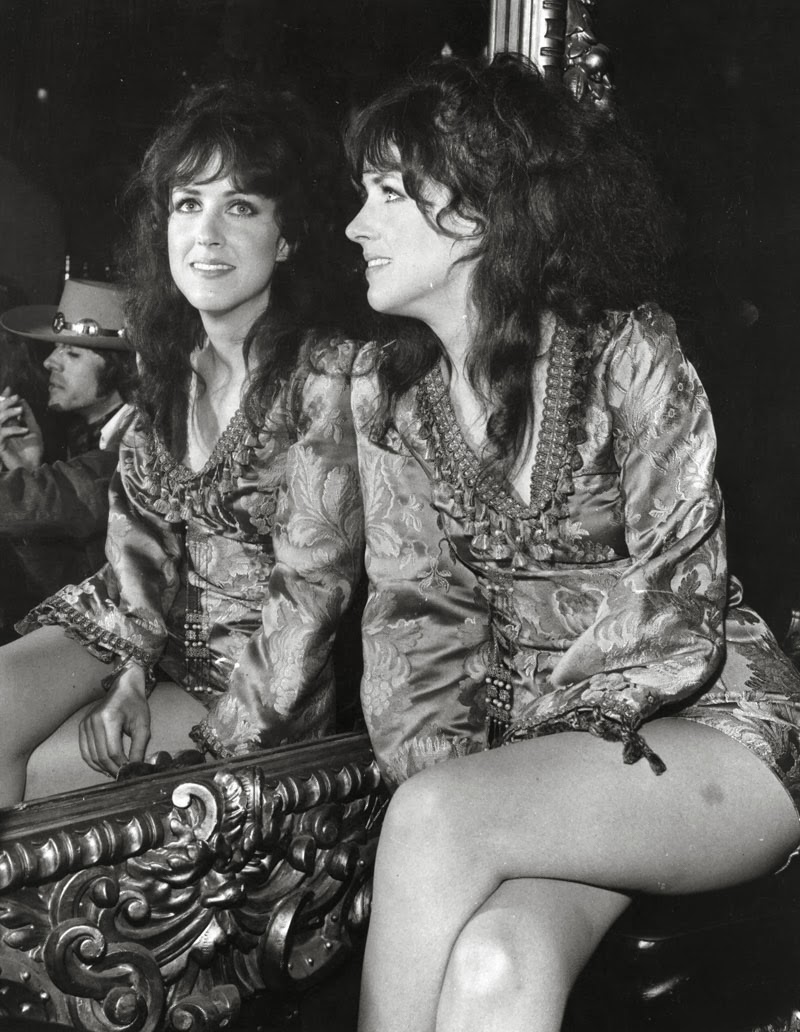
For this year's annual tribute to Scorpio birthdays I'd like to talk about the brilliant tornado that is Grace Slick, just turned 74 years old on October 30th this past week. A fearless, foolish, frequently outrageous artist always willing to take risks and in the process influence tens of thousands of female rock singers during and after her fame, she is a rock icon like no other.

There has never been a female artist as irrepressible as Grace Slick prior to her arrival on the music scene. In the mid-Sixties female artists were delicate, controlled, and easily led; but with genius, beauty and style Grace Slick arrived and changed the way women performed and appeared in the public eye. Artists like Patti Smith, Courtney Love and an endless conveyor belt of Diva of the Weeks owe her a tremendous debt of gratitude.

Grace's first band was in 1964 with her husband Jerry Slick (her name was originally Grace Wing) and his brother Darby named The Great Society. In 1966 they recorded what was to be her most memorable songs, "Somebody To Love" and "White Rabbit". One year later she left the band to replace Signe Anderson in Jefferson Airplane. With her pin-up model looks and intense beatnik style the Jefferson Airplane acquired a distinctive image to compliment their excellent musicianship.

Grace Slick's intense vocals in Jefferson Airplane were virtually unheard of in rock music up to that point and were the most intense female vocals heard at the time. Beginning with "Surrealistic Pillow" Grace forged a new sound in rock, combining beat poetry with vocals that effortlessly blended jazz ala Carmen McRae with then-popular folk rock melodiousness.

While Paul Kantner and Marty Balin wrote excellent folk tunes and Jorma Kaukonen wrote tough blues songs, a Grace Slick song promised a sophisticated, jazzy melody with a powder keg of lyrics about to explode. Her songs were works to be reckoned with.

Whether it was singing about a boy with arrested development in "Lather" or a filthy, polluted planet on "Eskimo Blue Day", no other female vocalist tore away at pompous masculine pride with feminist rage as she did with songs like "Two Heads", "Greasy Heart" or "Hey Frederick". And just as you're about to dismiss her as a bull-busting bitch she slips in a song as cool and surrealistic as "reJoyce", a gorgeous jazz piece based on the writings of James Joyce. Very, very bohemian.

Grace kept up with her male peers like Jim Morrison in the outrage department, too: performing in blackface on The Smothers Brothers Show, naming her publicly born-out-of-wedlock daughter "god", flashing her breasts onstage so many times it became shock-less, acts simultaneously outrageous and feminist setting new standards.

She can be forgiven her many excesses, alcoholism, fighting with countless boyfriends and policemen, and the crass, milquetoast New Wave band Starship whom boiled down their name from Kantner's original combo "Jefferson Starship". She can even be forgiven for making certain remarks that were bound to offend just about anyone with a pair of ears, but like all outlaws she probably wouldn't give a shit, anyway. That's punk as fuck.

Nice behavior or not, there's the records, some of the most unforgettable I've ever heard. It's amazing that nearly forty five years after the release of her records Grace Slick's lyrics and vocals can still send chills through me. And look beautiful doing it, too.

Suggested Reading:

Somebody To Love? A Rock and Roll Memoir
Grace Slick (with Andrea Cragan)
Warner Books

The Jefferson Airplane and the San Francisco Sound
Ralph J. Gleason
Ballantine Books

Saturday, July 20, 2013

"Then Play On" - Fleetwood Mac (1969)

There has never been a blues album like Fleetwood Mac’s “Then Play On” as it effortlessly transcends the blues genre while committing to its cardinal rules at the same time. It would be the last album group figurehead Peter Green would record with the band amidst a firestorm of controversy in the British music scene. The third album by the band and released in 1969, it was also their breakaway from Blue Horizon Records and the beginning of a very unique genre that wasn’t and still isn’t so easily defined.

The original Fleetwood Mac sound was that of a scruffy garage band bashing out classic Elmore James-styled 12-bar blues with a lethal dose of fuzz on the guitars courtesy of Green and Jeremy Spencer, whose incendiary slide guitar style hinted at more of an abrasive acid rock sound than simply adhering to trad blues conventions. Mick Fleetwood’s explosive drum attack was also more hard rock than South Side shuffle. All that would change by the time of “Then Play On”.

The band changed its approach to a dark, somber surf guitar sound with lyrics that progressed from standard blues issues to a more existential angst, questioning a man’s existence as well as his role in God’s creation. It is almost the blues equivalent to Syd Barrett’s album “The Madcap Laughs” in its vision of despair and loneliness, however, there were signposts up ahead that hinted at this new direction in sound.

Several tracks from past albums hinted at this new departure for them; on the first album there was the spare, bleak cover of Robert Johnson’s “Hellhound On My Trail”, Peter Green singing along to a very quiet piano; there was also “The World Keep On Turning”, Green singing alone to his acoustic guitar: “Nobody saw me crying, nobody knows the way I feel, the way I love that woman, it’s bound to get me killed”, and of course on the second album “Mr. Wonderful” there was “Black Magic Woman” and another quietly sad number with surf guitars, “Man of the World”: “I guess I‘ve got everything I need, I wouldn’t ask for more, And there’s no one I’d rather be, but I just wish I’d never been born”. Not exactly boogie time.

The darkest number in Fleetwood Mac's set up to that point was a live cover of Blue Horizon label mate Duster Bennett’s “Jumping At Shadows”: “Everyone points their hand at me, I know I’m just a picture of what I used to be, I’ve been jumping at shadows, thinking about my life”.

In “Man of the World”, the BBC documentary on Peter Green, Jeremy Spencer and Mick Fleetwood recall the turning point for the band when they arrived in Germany while on tour and were met by an attractive German jet-set couple who whisked Green and third guitarist Danny Kirwan from the airport to their chateau for an acid-drenched party that marked the two guitarists for life. Fleetwood and Spencer agreed that Green & KIrwan were never the same again.

The original plan for “Then Play On” was to make it a loose jam session as an antidote to the Top 40 singles success of “Albatross”, “Man of the World” and “Black Magic Woman”. The album does indeed have a schizoid relationship between bracing, fiery guitar jams, impeccably played like “Searching For Madge”, “Fighting For Madge” and the more cerebral “Underway” and “My Dream”.

On the other hand there are the dark, moody compositions like “Closing My Eyes”: “Someday I’ll die, and then I’ll be with you/ So I’m closing my eyes to hear the people laugh”, or “Show Biz Blues” with the immortal lines, “Tell me anybody now do you really give a damn for me”. The lightest point on the record for Green is his ode to masturbation, “Rattlesnake Shake”.

Danny Kirwan begins to shine on this album with full-bodied melodic compositions that lighten the mood somewhat, the Everly Brothers-influenced “Like Crying”, the Buddy Holly-sounding “Although The Sun Is Shining” and the pre-Santana influence “Coming Your Way”. His songwriting became even more refined and melodic on the more rocking albums “Kiln House” and “Bare Trees”.

But it’s still the rapidly diminishing shadow of Peter Green that dominates “Then Play On” with “Oh Well”: “Don’t ask me what I think of you/I might not give the answer that you want me to”, or the defeatist sound of “Before The Beginning”: “I’ve got to find a place to sing my words, Is there nobody listening to my song?” Green followed up “Then Play On” with his darkest and most legendary composition, “The Green Manalishi”. Following the release of the single he left the band, dabbled in several religions, released an album titled “End of the Game” and began a downward spiral which sent him in and out of several mental institutions. Although Green eventually bounced back – he still seems a little odd in his documentary – Kirwan never fully recovered from his breakdown and has been homeless for years.

What makes “Then Play On” (taken from the William Shakespeare line, “If music be the food of love then play on”) a legendary work of rock music is the way it stays within blues constraints yet takes it to a place that goes beyond sex, drugs, love, liquor or anything materialistic: it’s the blues of a mere mortal on God’s earth and the utter feeling of powerlessness. The musical palette the band creates on this album completely sets a tone of darkness and isolation that evokes feelings of sadness that the blues are meant to express. And that’s why “Then Play On” is one of the most timeless blues albums ever recorded.

Next month Rhino Records will be releasing an extended version of “Then Play On” with “The Green Manalishi” and its B-side, “World In Harmony”, among other extra tracks.

Saturday, June 8, 2013

Going Downtown With Carter Brown

There has never been a beast so strange as the paperback publishing world, a once inexplicable planet where writers could make a fortune without garnering much respect in literary circles. I'm not referring to modern potboiler stars like Stephanie Meyer or Robert Ludlum. I'm referring to someone like Harold Robbins, who pretty much in his time had a stranglehold on the bestseller charts with tomes like "The Carpetbaggers" and "The Dream Merchants".

His books have sold in the billions worldwide. When people talk about great crime writers the usual names crop up: Raymond Chandler, James M. Cain, Donald Westlake, Elmore Leonard. Few ever mention or even care about Carter Brown, who in his time (1962-1972) sold millions of paperbacks worldwide. Who is Carter Brown?

Carter Brown in actuality was an Englishman whose real name was Alan Geoffrey Yates. Originally a PR writer for Qunatas Airlines in Australia, Yates turned to writing pulp fiction westerns, sci-fi space operas, and even romance weepies novels under assumed names. Every Carter Brown crime novel took place in America, and it has been rumored that a ton of them were written before Yates even set foot in the States!

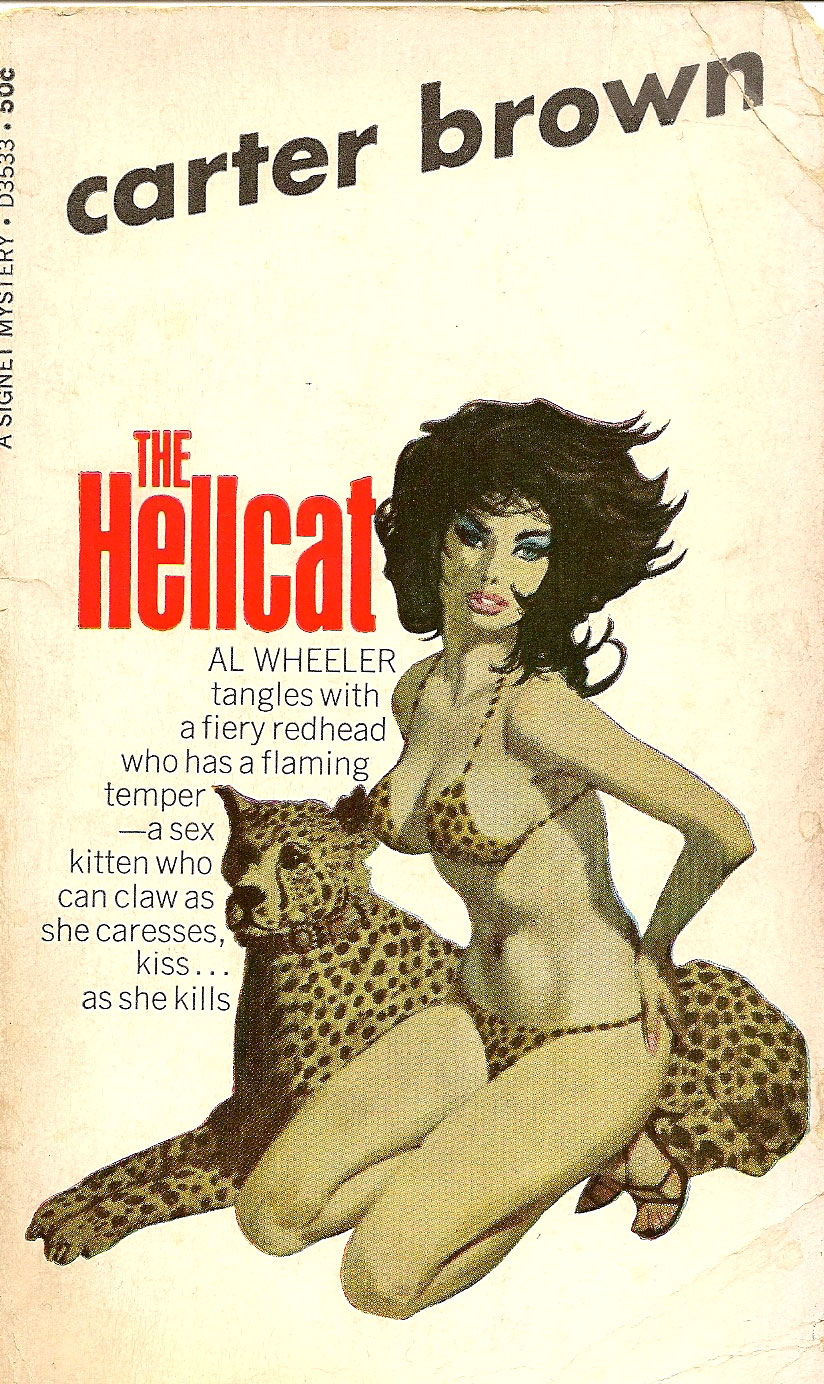
The three most popular recurring characters in Brown's novels are Police Lieutenant Al Wheeler, private eyes Rick Holman, and dumb bunny detective Mavis Seidlitz (with the 38-24-36 measurements). Whichever character Brown featured in his novels you were always guaranteed a lot of smoking, drinking, and sexing up. In other words, Carter Brown novels were cheap Swinging Sixties pulp fiction at their sleaziest. Just to amp up the sleazy sex factor, each brief paperback clocking in at usually 120 pages a piece all featured covers of skimpily clad goddesses by the great Robert McGinnis.

For those who dig the Peter Gunn, Johnny Staccato and 77 Sunset Strip TV shows, Carter Brown is more of the same. Hard lovin' swingin' and two-fisting private eye with killer dames who drop their drawers before they swing their fully loaded .357 Magnum at yr. skull. Smoke a Lucky Strike and crack open a Carter Brown novel, it ain't noir, it's better than noir, it's sexy trash.

While I haven't read enough Brown books to qualify as an expert on his work, I'd like to weigh in on some of my favorite books I've read by him:

The Corpse: Lt. Al Wheeler’s on the case of the mystery of the annoying, drugged-out hepcat that got iced in front of the bandstand at the hippest beatnik jazz coffee house. The only reason his murder’s a big whoop is because he’s the son of a powerful newspaper magnate. The Fifties jazz club vibe of the book will remind you of John Cassavetes’ terrific detective show, “Johnny Staccato”. Lots of babes, booze, billionaires and beatnik bongos abound. The Robert McGinnis cover doesn’t disappoint either.

W.H.O.R.E.: One of the more surreal detective novels ever written, police Lt. Al Wheeler runs afoul of a gang of psychotic killers in Mickey Mouse and Donald Duck masks. The Mickey and Donald-mask wearers are strike breakers who plan on assassinating a Cesar Chavez-style protest leader who's making plans on marching down the Grapevine with his fellow fruit pickers. And that's just the first sixteen pages!

Somewhere in the mix, of course, are a team of deranged feminists called W.H.O.R.E. If it sounds crazy, just remember this was published in 1971 when exploitation films like "Sweet Sugar" and "The Mini-Skirt Mob" were at their apex. Unless Carter Brown's estate is controlled by an iron fist there's no reason why his wild novels aren't being reissued by Stark House or Hard Case Crime.

Tomorrow Is Murder: More Sixties sleaze from Carter Brown about a sexy psychic predicting a millionaire’s death on a Joe Pyne-style TV talk show. The PI this time is Mavis Seidlitz, a bodaciously stacked bimbo blonde in the Little Annie Fanny tradition. She’s on the case in groovy Venice circa 1960, busting up bongo beatnik coffeehouses and catfighting witches into Beverly Hills poolsides. Carter Brown never disappoints.

The White Bikini: Quick, entertaining sleaze about a Hollywood party girl found dead on the beach who may be the daughter of a high-powered movie studio executive. The trail to murder leads private eye Rick Holman to oversexed folk singers in coffeehouses of Venice, psychotic bodybuilders in Muscle Beach, and studio brats spinning roulette wheels in Las Vegas. Trashy good fun that embraces Sixties culture at its wildest.

Other Carter Brown book titles you may not have heard of: Who Killed Dr. Sex?, No Tears From The Widow, The Flagellator, The Ice Cold Nude, No Blonde Is An Island, Nymph To The Slaughter, The Bump And Grind Murders, Walk Softly Witch, and countless more!

Without belaboring the point that Carter Brown novels are sleazy but entertaining trash, there are no philosophical soliloquies that you get in a David Goodis classic or some deep existential journey into darkness like Jim Thompson. Like his contemporary Mickey Spillane, Carter Brown served up pure entertainment dressed up as a sexy crime novel with insanely generous servings of pop culture trash: surfing, beatniks, hippies, strippers, health food freaks, fitness and yoga clinics, pill - popping psychiatrists with nothing but sex on their minds, etc. Compared to the crimes committed on shows like "Breaking Bad" it just seems quaint in comparison.

Saturday, June 1, 2013

MC5 Or DC5?

If there is a more burning question than "Boxers Or Briefs?" it's the big musical question: MC5 or DC5? Not that its impossible to enjoy the music of both bands, but there is a slight generational difference. In some ways they're surprisingly similar - both bands have an affinity blues/jazz only presented differently, and both are also extraordinarily LOUD, especially for their time. Let's weigh both bands:

The MC5 (Motor City Five) were the pride of Detroit, Michigan in 1968 and well initially well-known for aligning themselves with John Sinclair's White Panthers Party, not quite as menacing as the Black Panthers, but still a great gimmick, forerunners to The New York Dolls and their red leather drag and Communist flag shtick and many others following that.

In 1969 several labels hit pay dirt cashing in on the Detroit sound, like The Bob Seger System, The Frost, The Amboy Dukes, SRC, The Stooges, Grand Funk Railroad with even Alice Cooper stopping by for an extended residency. Elektra Records signed the MC5 for the terminally loud 'n proud "Kick Out The Jams" showing the band ripping it up with bottomless American flags rolling down miles and miles behind them.

One of the brilliant highlights of Kick Out The Jams was the choice of covering Sun Ra and The Troggs on the same record, pretty audacious for its time and a definite influence on me, as well. If free jazz can't be played on electric guitars then it can't be played on anything, dammit! Wayne Kramer and Fred "Sonic" Smith clearly defined the band's sound with their wild, barley controlled screaming guitars.

Back In The USA was considered a disappointment when it was released, but I think after the utter Mad House riot Revolution In The Streets vibe of the first album a more controlled affair was in order, so you got more poppier songs like Shakin' Street and High School. By the time High Time was released the band was back in full psycho abandon with tracks like Sister Anne, Sonically Speaking - back to the jazz saxes honking like mad - and Future Now.

I'm the usually the last to hear good news about anything, so I just recently heard that in 2010 Dave Clark finally turned over at least ten albums worth of material of DC5 (Dave Clark Five) music, three of them containing either unreleased or obscure tracks that barely got its minimum daily requirement of oxygen. Unfortunately they're only available on iTunes, so it's time to pay the Apple piper again. But I digress.

The DC5 were such a powerful force during the British Invasion that they knocked The Beatles out of the Number One position in the charts and in their prime were two steps behind The Fab Four everywhere they went. They followed The Beatles as the second English band to play on The Ed Sullivan Show. It was that serious, but why not? They were sensational.

Unlike the MC5 there was more than guitar army reconnaissance going on: the DC5 had some wicked blues organ playing from singer Mike Smith, who wrote most of the material, and wicked raspy saxophone playing from Denny Payton. Denny Payton occasionally overdubbed his tenor and baritone saxophones together on several songs, sounding not unlike that badass Dana Colley from Morphine.

With Mike Smith's snarling vocals mixing with Dave Clark's military march pounding (pre-dating Gary Glitter's homo stomp by a good 10 years!) and Payton's growling mad dog saxophone, the DC5 tore into R&B standards like "Do You Love Me", "Reelin' and Rockin'" and "I Like It Like That" with vicious abandon.

Equally exciting is the new, unreleased material like "Fallout Shelter", "The Man In The Pin Stripe Suit", and "Return My Love". And how great is it that we can finally enjoy songs like "I'm Thinkin'" and "Say You Want Me" in digital panorama sound instead of that scratchy Epic Records vinyl. Nostalgia is nice but pops and hisses aren't and a good, clean polish only makes the songs sound more demented.

The influence of both bands is far and wide, almost hard to even estimate: MC5 have influenced bands like Radio Birdman, KISS (esp. High Time, listen to Baby Won't You or Over And Over) and The Didjits. The DC5 have clearly influenced bands as varied as The Monks, Slade - check out the stomping drums! and The Ramones, who covered the sublime Any Way You Want It.

If you haven't heard the MC5 lately dust off their records and turn it up, especially Sister Anne. And if you haven't checked out the DC5 on mp3, now's the time to do it before Dave Clark pulls a Walt Disney and pulls the tracks off the shelf, which he's done before. I guarantee it'll clean your clock!

Thursday, January 24, 2013

"Paul Smith: Gentleman Designer"

To be perfectly honest the world of menswear hasn’t seen too many designers of utter genius. Rei Kawakubo (Comme Des Garcons) and Burberry immediately come to mind, Kenneth Cole comes close, but for the most part the most brilliant work has been largely reserved for women’s fashions. Then there’s the work of Sir Paul Smith, letting us in on what makes him tick in a recent French television documentary. Every thing he says and does in this doc can serve as a valuable lesson in fashion design.

Originally from the town of Nottingham, Paul Smith opened a boutique with his future wife Pauline, a fashion student from the Royal College of Art. She pretty much steered him in the right path of design, which helped build his name by combining vintage British tailoring with colorful and occasionally flamboyant fabrics, lining choices, notions and unique finishing. Because he started with average, white shirting material, he decided that the only way to stand out from the pack was by jazzing up the finishing and implementing unconventional colored buttoning, never forgetting his trademark multicolored stripes emblem, looking like some unholy psychedelic bar code. The Paul Smith approach from Day One was to continue the tradition of British tailoring with enough weird tweaks to keep it new and eccentric.

Shown in his Covent Garden office with thousands of books, toys and swatch boards surrounding his desk, Smith works in his headquarters on 20 Kean Street, a five-story building which also houses his assistant designers, art and marketing staff. Smith even takes time out to goof off with his vintage Mr. Machine toy – I’ve got one, too! Anyway, he’s shortly seen conducting an office meeting with designers and managers about the focus and concept of his new line, using of course vintage rock album covers. But dig the bizarre choices!

Example Number One are photographs of Sixties era Frank Zappa(!) wearing an occasional suit, looking smart and dapper, but not without Smith mentioning that Zappa also wore a gorilla-fur coat. The point being made is that in Rock & Roll smart tailoring goes hand in hand with the unexpected. His head designer Simon steps up and shows custom printed textiles influenced by album cover art.

Example Number Two is The Stone Poneys, Linda Ronstadt’s pre-solo folk band with Smith pointing out cool folk-rock style, mixing vintage beatnik with then current acid rock looks as a target design. This style at the time consisted of heavy coats, tight striped pants and furry hats, a style best popularized by John Philips of The Mamas and The Papas, among others.

Example Number Three, if it wasn’t weird enough, is Kraftwerk and the Kraut Rock look in general. Kraftwerk's tailored and dapper looks from "The Man Machine" and "Trans-Europe Express" are held up as examples of clean lines and fine-line tailoring. The bottom line, Rock & Roll has always been about style and fashion. My blog title last year said it all: “Once Rock Stars Looked Like Models But Now Models Look Like Rock Stars”.

Coming from most designers, the whole R&R fashion rigmarole would sound like so much chin music – John Varvatos, great fan that he is, can get tiresome with his fandom, but Smith is the real deal. Smith talks about his youth in Notting Hill, sleeping on floors with legendary blues musicians like Zoot Money and Grahame Bond.

British rock style in the Sixties, Sir Paul explains, put a twist on traditional British dandyism by incorporating women’s fabrics for men’s tailoring at bespoke tailors on Savile Row. As a result, sometimes bands were ripped off by the tailors when they used old curtain fabric rather than real material, passing it off as psychedelic enough to be cool. Smith proudly shows off designs he made for bands like Led Zeppelin (trousers for Jimmy Page!) and Pink Floyd.

Not above clowning around in front of the camera and or his staff, Smith even advises his Paris Fashion Week models (including Andrej Pejic and a frightened-looking Miles McMillan) that it’s okay to look happy and even smile when walking down the runway. The down to earth attitude about fashion includes modeling, where it’s stressed that models need to look interesting rather than gorgeousperfect.

A designer as celebrated as Paul Smith could very easily just rest on his laurels and take himself seriously like less-successful designers (he has 200 stores in Japan alone), but what makes Smith so cool is his restless search for inspiration and lack of propriety in an art and industry increasingly ceremonial to the point of atrophy. In this regard, Smith might very well be one of the most Rock & Roll designers in an industry rampant with imposters.

Thursday, October 25, 2012

Happy Birthday Jim Steranko

This year’s annual Scorpio birthday tribute goes out to comics legend Jim Steranko. Along with Neal Adams, Steranko brought a maturity to comics in the late Sixties that completely changed the way people saw comic books, Adams with DC’s Deadman in Strange Adventures comics and Steranko in Marvel’s Nick Fury, Agent of S.H.I.E.L.D. Jim Steranko brought graphic style in a medium that was still mostly stuck in exaggerated, cartoony caricatures. Steranko’s art style brought comics into the Swinging Sixties, incorporating elements of Pop Art, colorful psychedelia, and cinematic images mostly influenced by Mario Bava films (ref. Black Sabbath, Danger: Diabolik, Blood and Black Lace, etc.).

A Jim Steranko comic book cover leapt off the stands every month; no other comic on the newsstand even looked like his or even came close. Steranko’s first work for Marvel was Nick Fury, Agent of S.H.I.E.L.D., a poor cash-in on the James Bond spy movie craze featuring a post-war Sgt. Fury with a few of his Howling Commandos on board (Dum Dum Dugan and Gabe Jones). The series was barely breathing oxygen providing support to the superior Doctor Strange in Strange Tales Comics. Steranko originally drew layouts for Jack Kirby in the series but eventually took over the art reins, then taking over the writing reins from Stan Lee and Roy Thomas, gaining complete control over the series and taking it places not seen in comics at the time.

One of the best examples of Steranko’s graphic genius is the legendary cover to Agent of S.H.I.E.L.D. #4, often imitated to the point of even The Simpsons comics doing a tribute to the cover. In addition to Agent of S.H.I.E.L.D., Steranko blew minds with his work on Captain America, X-Men, and a cover for The Incredible Hulk that has to be seen to be believed!

A new Steranko comic release in 1967-68 was as eagerly anticipated as a new Beatles single, in that it heralded an exciting new way of seeing things. A lot of other kids must have agreed with me because they were some of the fastest selling comics to fly off the stands. It took me years to score Agent of S.H.I.E.L.D. #1 because it instantly sold out on release.

Jim Steranko, born November 5, 1938 in Reading, Pennsylvania, grew up working in carnivals as a fire-eater, magician, and later resorted to burglary. He also got heavily into playing guitar in various local bands. After a period of commercial art, Steranko moved over to illustrating several short-lived superhero series for Harvey Comics.

Steranko’s legendary work for Marvel gave him artistic control that included splash pages in the middle and end of the comic, sometimes even taking up two pages, unheard of at the time. He also colored his own comics, a first at the time. All this artistic freedom eventually came to a head when Marvel big kahuna Stan Lee began heavily editing Steranko’s previously untampered work,creating major friction between the two men.

Steranko’s next move was to start his own publishing company Supergraphics, which produced the Steranko History of Comics in 1972, one of the earliest academic studies on the history of comics. By the 1980’s he published Prevue Magazine, an aggressively heterosexual movie magazine that always managed to plug in a few photos of Sybil Danning and Steranko clutching some hot, new young blonde action movie starlet.

Jim Steranko was inducted to the Will Eisner Hall of Fame in 2006, and continues to this day to be a major influence in comics art. Like a Sam Fuller film, Henry Moore sculpture, or Captain Beefheart album, once you’ve seen a Jim Steranko comic you know you’ve seen something incomparable and unforgettable.

Thursday, October 18, 2012

Batman Por Vida

In his autobiography “Back To The Batcave” Adam West remarked that the three pop culture phenomena of the Sixties in America were “Bond, Beatles and Batman”. While I never engrossed myself in the marketing of the first two icons I always had room for buying all the 1966-era Batman stuff I could get my hands on.

A major factor in the Batman TV show’s success can be attributed to the way it was so deeply entrenched in the sonic boom of Sixties teen culture. Villains like The Joker and The Riddler had gang molls that looked more like go-go dancers than Virginia Hill, wriggling like they just jumped out of their discotheque cage, The Batmobile was Kustom Kar Kulture at its wildest, and Batman himself hit the discotheques in an early episode doing a bastardized Watusi called “The Batusi”. Batman showcased more teen hipness than Patty Duke, Gidget, Dobie Gillis and every teen TV show combined. The only show to match it for teenage grooviness was The Munsters, but Batman had one thing The Munsters didn’t have – COLOR.

No matter who the villain was – Penguin, Riddler, Joker, etc. – they never dressed in black, foregoing it for comic book shades of purple, green and hemorrhage red. Batman’s cape and cowl was a cool midnight blue, a visual respite from the dreary black rubber nightmare he’s been draped in for the past twenty years. Next to G.I. Joe no other toy captured my imagination more in the Sixties.

I stayed away from textile based souvenirs like sweatshirts and towels and focused more on the vinyl-based toy media. There was the Batman soaky, a figurine that held bubble bath for dirty kids, the Ideal hand puppet that eerily resembled Adam West, or the vinyl Batman wallet with the brilliant Carmine Infantino artwork. There was the Colorforms art board where you could move plastic cut-outs of the Dynamic Duo around, and the great lunch box which shows Batman and Robin fighting the nefarious Penguin.

Then there were all the paperback cash-ins, some were silver age reprints and some were cheap novelizations. There was the 3D comic book, again with The Penguin seen fighting them (what’s the deal with The Penguin?). I also owned the View Master of Batman, a portable slide show you could watch, the series showing stills from the great Catwoman episode.

There were all the cool exploitation records I had, like the 45 rpm of The Spotlights rockin’ out on Batman & Robin, written, performed and produced by Leon Russell. There was the “Jan & Dean Meet Barman” album, which transposed Gotham City over Surf City (big surprise!).

Thirty years after the Sixties Batman craze died out Bruce Timm, a former animator from the Ralph Bakshi Animation studio (New Adventures of Mighty Mouse) helmed the Animated Adventures of Batman in 1996 for Fox Television and a whole new onslaught of great Batman merchandise returned. The artwork and designs were far more stylish than its earlier predecessor due to Timm’s brilliant eye for design and excellent makeover of tired and long-forgotten villains (Scarecrow, Clayface, Poison Ivy) and short-lived heroes (The Demon, The Creeper, etc.).

It was back to the toy store in the Nineties to grab all this awesome swag, which included cool figurines, a Bat signal night light, toy Batmobile and Batgirl motorcycle, plus a new Nineties soaky and Nineties lunch box. I hit the Warner Bros. store on an almost weekly basis to catch the latest merch on Batman, The Joker, Harley Quinn, and all the rest.

The ultimate book on this merchandising craze that’s spanned several decades is “Batman Collected” by Chip Kidd, (Watson-Guptil), an eye-popping collection of images and details that doesn’t leave any stone unturned on all things Batman.

There are basically two kinds of toy collectors out there: one, the kind that want bragging rights for owning a collector's item, and two, the kind that love their toys and treasure the memories that they bring. I’ve only acquired the things I really can’t live without and enjoy looking at day after day. Happiness can’t be bought but it can bring a few smiles now and then.

Saturday, June 18, 2011

The American Nightmare of Frank Perry

There may never be a film director more incisive at filming the American Nightmare than Frank Perry. For over thirty years he has made films that deftly articulated the despair of American life.  Although he was fortunate enough to garner big stars and major studios to fund his projects his films never failed to disturb people for their ability to hit nerves that didn't want to be tampered with.  In light of so-called "genius" auteurs like Tim Burton with his tired goth fantasies and David Lynch with his dancing midgets Mr.Perry remains more relevant than ever.

Most of his best films were written by his screenwriter wife Eleanor and her contributions were no less brilliant.  Most of their films were adaptive works and her ability to remain true and in certain cases even exceed the impact of the written works is an amazing feat in itself.  The six most intense films by him are as follows:

David and Lisa (1962): His first film was a revelation, the story of two highly dysfunctional teenagers learning about trust and dependency in a society that doesn't want them (watch the field trip scene to see tolerance denied). Janet Margolin ("Take The Money and Run"), Keir Dullea from "2001: A Space Odyssey", and HUAC black-listed actor Howard Da Silva star give amazing performances.


The Swimmer (1968): Burt Lancaster has played many cerebral roles in the past but this may be his magnum opus, playing an aging family man from the suburbs who plans on swimming his way back home via his neighbor's swimming pools. Considering Lancaster's past as a physically fit trapeze artist reaching the autumn of his years the role seems tailor-made for him. As the film progresses we realize he is a philandering, morally decrepit business executive newly released from a mental institution. Just like the cycle in a life he's treated with love and respect (infancy) and by the end he's hated and reviled by all (old age).  From the short story by John Cheever who even makes an appearance in the party scene, Eleanor Perry's adaptation fleshes out the story brilliantly, even reportedly incurring jealousy from Cheever himself.

Last Summer (1969):  Basically the YA (Young Adult) movie from hell, two teenage boys (Richard "John Boy" Thomas and Bruce "Willard" Davison) befriend a cock-teasing teenage girl (Barbara Hershey) on the beach. Just when their hormone-overdriven hijinks begin to bore an overweight, homely girl invades the triangle and the trio play cruel, sadistic games on her including setting her up on a fake date. The girl is spared none of the mercy shown a crippled sea gull at the beginning of the movie.


Diary of A Mad Housewife (1970): Richard Benjamin plays the most obnoxious, annoying husband in the history of the cinema, nagging his suffering wife played by Carrie Snodgress to death. His snobbery is so over-the top it puts Patrick Bateman to shame. She meets a very mod Frank Langella at a groovy Manhattan party featuring a very young Alice Cooper ("Easy Action" era). Scads of wild sex ensue, bringing out the sexual vixen held back by her suffocating Manhattan brownstone bourgeois family.

Play It As It Lays (1972): Based on the Joan Didion novel, Tuesday Weld plays the manic depressive ex-actress wife to a temperamental film director. Her idea of fun is doing large quantities of speed and driving like a demon on the freeway for hours with no destination. She's reunited with her "Pretty Poison" co-star Anthony Perkins, who plays a gay film producer and her conscience. Frank and Eleanor divorced before the film was made so the film's pacing lags terribly since her contribution was absent.

Mommie Dearest (1981): Similar in tone to "Diary of A Mad Housewife", only this time the sadistic wretch is Joan Crawford and the sufferer is her daughter Christina. I have to confess I never believed for a minute this was a true portrayal of Joan, but that didn't tamper with my enjoyment of this ridiculously insane film. Faye Dunaway is perfect in the role and rumor has it that she didn't have to do much acting to play the psycho actress. Notice the padded walls in her bedroom, a great touch kicking off the creepiest opening credit sequence in movie history.

Frank Perry passed away eight days after his 65th birthday from prostate cancer. The last thing he filmed was a documentary of his battle with the disease and it was no less intense than his fictional movies. Needless to say he appears angry all through the film.  Like the rest of his movies this most definitely doesn't end happily, but happy endings are a con, anyway. His films, although European in tone like the finest Bergman, remain idiosyncratically American and shine a light on the darkness which we call the American Nightmare.