Saturday, October 11, 2014

Producing Is 10% Seducing and 90% Reducing

In the course of playing music in the past twenty-two years I have produced four albums of my own, remixed two for other performers (Michael T and No Policy), released countless singles and compilation tracks as well as played on a million other bands' records like Pressurehed, Ether Hogg, Anubian Lights, and a few others. If there's one thing I've learned in all those years is that no two recording sessions are alike. Musicians never get to say that each day in the studio's like "just another day at the office". It never is.

Generally, there are basically two kinds of producers: highly skilled, well-seasoned engineers who can work miracles in the studio and make any band sound brilliant, or someone who sculpts the band's sound and carefully arranges all the songs so he goes into the studio with the sound already worked out completely in his/her head. I belonged to the latter camp.

ARRANGING: My band Trash Can School had three guitarists and I had a pretty good idea of each one's strength and weaknesses, so when it came time to arrange the guitars I already had a clear idea of who could play which part the best. One guitar was delegated the lead, one for the rhythm and the third would play fills to thicken what the other two guitars were doing.

If one song needed a fast, complicated solo the first-string guitarist would get it, but if another song needed a slow, simple solo then the rhythm guitar played would get the lead, because they were usually good at that sort of thing. It always worked out real well.

Some guys played slide better than the others so they got the lead part to show off their slide guitar skills. It was great having three different guitarists with diverging styles to choose from. The funny thing was that Trash Can School was the reverse of the old Fifties band where there was one guitar and three horns, with us it was one saxophone and the three guitars, a veritable guitar section. The result, on tracks like "Silver Surfer", was astonishing.

Whenever I arranged a song I always thought of showcasing a band member if it enhanced the song, which is why I stuck in a wild Gene Krupa drum break in "Yes I Mean No", or a melodic pulsing bass solo in "Pistol Whipped/Pussy Whipped". I wanted to give everyone a chance to show their stuff.

When it came to arranging covers I wouldn't tackle anything unless it fit within the parameters of what we could play. We tinkered around with "Horses" by Patti Smith by playing the first half of "Gloria" and the second half of "Land" as a slide guitar drenched dirge. After performing "Shove" by L7 a few times and getting bored with it I decided to gravitate towards "Godzilla" by Blue Oyster Cult, which sounds identical and allowed me to insert a ripping saxophone solo on top of it. Later on in Cockfight I covered The Plasmatics' "Sometimes I" and gave it a driving, moody Cramps back beat.

RECORDING: But enough about arranging, let's talk about the recording process: some of the best recording studios I've worked in were as small as a living room, which is exactly what Radio Tokyo was, a converted living room in a craftsman style house. We got some big sounds there.

Setting levels is something adjustable to your preference, but one thing I distinctly went for on my records was more of a jazz drum sound. I always veered towards rhe ride cymbal rather than the crash cymbal. A rock record will always emphasize the crash cymbal but I went for a hot ride cymbal sound. The ride rules in jazz; the crash rules in rock.

I also think too much baffling can make a record sound too sterile and flat. Baffling for those who aren't familiar with the expression is when baffles, which are large dividers, are placed between the drums and the guitars and the keyboards so each instrument gets a good, clean sound in their channel. I always enjoyed working at Radio Tokyo because of all the leakage in the room. Leakage means when the other instruments sonically leak into each others tracks, which gives the band a definitely live sound.

My records sounded pretty live to me but there always a few people who said my "record didn't sound like the live show". Of course not. When I'm in the studio I have a large vocabulary to work with in terms of effects and instrumentation. Why would I want it to sound like a live show when I can make it sound so much more dynamic? Some people think too small.

On the other hand there have been reference vocals that turned out better than the polished vocal, like when I kept the Yoko Ono braying in "Powershred" that was originally meant to mark the saxophone solo, but it sounded do witch-like I kept it in.

Another reference vocal I kept was in "Liquor Store" where I overdubbed a more frantic vocal over the reference, then we lower the octave eon the reference like a slowed-down record, so you get a double vocal with different octaves. I was pretty happy with the end result.

Now as the title of my essay states, producing involves seducing, also known as persuasion, persuasion meaning making musicians play things that they either don't think they can play or simply won't play because they don't think it "fits their style". While there's nothing wrong with having a style, it's an artistic thumbprint, I know, it wouldn't hurt to expand their skills to make their bag of tricks that much more exciting.

As a result I have assured many musicians that they can play all sorts of strange things they're not accustomed to doing. Reluctant at first, after a few takes they actually find themselves very excited in the knowledge they've just expanded their vocabulary because somebody believed in them. I've never accepted a drummer saying "I can't play that" or a guitarist saying "That's not what I'm known for". Too bad. You begged to play in my band, prove to me you were worth the trouble of my bringing you into my band.

Sometimes you have to make lemonade out of lemons, like when the drummer came in a beat too late at the beginning of "Horses". Instead of throwing a fit about it I simply overdubbed a horse whinnying saxophone line covering the flaw, which enhanced the drums kicking into the song pretty well. Happy accidents mean covering any flaws that happen during the recording process.

I hate the idea of having the band just coming in and playing the same rock band crap over and over again. I'm definitely a fan of bringing in sound bites, non-rock instruments like vibes on "Hardware", or even industrial percussion, like Ted Carroll of Distorted Pony banging on car parts during "Godzilla". Once you're in the recording studio you have an unlimited palette of sounds to work with. Fuck this live band sound bullshit.

Sometimes the way you visualized a song in your mind doesn't pan out the way you wanted it to once you get into the studio, and it's a battle you sometimes can't win, so be prepared to let go, or else you'll just go crazy. You'll have to settle for less than perfection, or to put it more coldly: IF YOU CAN'T GET IT DONE IN FIVE TAKES IT CAN'T BE DONE.

MIXDOWN: Many terrible recordings have been saved through the magic of mixing tracks and adding effects to make the unlistenable sound listenable. Its truly miracle working made flesh. I remember leaving the studio after recording "Baby Lust" and almost crying, thinking I'd just wasted my money on a shit recording. I called Donnell Cameron at Westbeach Recorders and booked some time and he helped me save this track from being a bomb to being a hit.

I already had some familiarity with Donnell's work when he pre-mastered my track "Silver Surfer" for the Flipside compilation "City of LA Power". Donnell had a pretty unique approach to mixing I'll never forget. Halfway through mixdown once our levels were set and we did a rough mix of the song, he would transfer the tape to cassette, and then pop the cassette into the world's most beat up boom box I'd ever seen.

"Okay, we know what it sounds like on some nice, big, expensive studio speakers. Let's hear what it'll sound like booming out of your car".
The song started playing on this dinky player and all the cool parts as well as the shitty parts rang through loud and clear.

"Well, dude what do you think?"
"Wow, this makes everything sound totally different", I opened my eyes.
"Track definitely needs more low end and the vocal needs to come up higher. A little chorus on the guitars should smooth out a lot of the overdrive on the treble".
"Yeah, I agree. Let's go back in and make those changes".
I think we did the Ghetto Blaster Test two more times as we went along, the last pass being the final mix and sounding pretty majestic.Donnell's a brilliant engineer and we got a wild Plastic Ono Band sound on that crazy song.

Getting Geza X and his studio on my album Volume War was great because we already had a history together. He mixed the sound for The Screamers when I played with them and we played in our punk big band Arthur J. and The Gold Cups in the late Seventies. His guitar playing in The Deadbeats was legendary for its twisted inventiveness and made even more manic in his solo configuration Geza X and The Mommymen.

We also shared an affinity for avant garde music, so I didn't have to explain myself or my strange musical ideas to him. He already knew where I was coming from, so there wasn't a lot of head scratching as some engineers did whenever I asked them to use weird effects or filters on my tracks. In fact Geza came up with a lot of great sounds and contributed greatly to the hairball cacophony of that record.

Mixing tracks also gives you a chance to have the last word in the recording process. I had a guitarist who had to end every track with an orgiastic wail of long, long droney feedback. EVERY track. Instead of losing my shit after every take I simply thought, "Well, we'll see about this idiot's feedback orgy when it comes to mixdown". Once I was alone with Geza X in the studio, we'd look at each other smirking and do a quick audio fade on his track as soon as that clown would do his feedback dick slapping. Geza X is the best recording wizard on the planet.

Then there was another time when the rhythm section in Cockfight decided to have a party the night before our recording session (GOOD TIMING, ASSHOLES!) so they ended up hungover the next day at recording. And they played like a pair of bombed out dick heads. The drummer was guilty about his shitty playing he offered to pay for the session. I said, "No, the damage is already done, thanks a lot".

When it came to mixdown Randall O'Malley and I did a lot of jumping up and down of levels with the drums whenever it was time to hide his fuck ups. It was like an audio trampoline. No shit. There were some parts that were so tore up that we had to throw a few space echoes just to hide how shitty he played. Thank God for Randall O'Malley, he rules.

The funny thing is that after all the bullshit you go through you DO end up with a great record that makes other bands want to use your engineer and recording studio, and sometimes even your musicians. The magic is in the music and the music needs your magic.

Friday, October 3, 2014

American Biblioteque

It's been years, nay, decades since I really bothered going to the library. Most of the ones in my neighborhood were stuffy and understocked with books and what they had was simply awful. I was pretty disgusted with the Ivar Avenue library in Hollywood, especially since they remodeled it to look like a maximum security prison, and the Gardner library by the old Pan Pacific Park of my childhood looked like an unmade bed, books and videos scattered in a heap all over the book shelves. It was depressing enough to swear off getting a library card forever.

It wasn't until seven years ago that I walked into the Santa Monica Library and it turned my head around about the book lending game. Modern but beautiful, it had a used book store inside as well as its own built in coffee house with lux patio. Even better it had a considerable collection of art books, instructional foreign language CDs (Farsi, Chinese and Russian, get it now), and a great YA selection. I was pretty blown away by the choices. And I haven't even gotten around to the impressive DVD section, large enough to rival any DVD store.

What also killed me about the library was the amazing CD selection they had there. What was the point of listening to Pandora or Spotify if I can rent out any Neil Young or Psychedelic Furs CD or the amazing "Mingus Dynasty" with Cholly all done up on the cover like Po Xiangyang. The amount of rentable music made me crazy, never mind the String Quartets or Baroque Trumpet Sonatas, you could get Public Image Ltd. or the entire David Bowie collection for nothing.

But, alas all good things must come to an end: as of last year, the Santa Monica Library imposed a $25 annual fee for all borrowers not residents of their fair city. Yes, proof of local ID was required. I needed to get my fix of Joe Lansdale and Robert Cormier classics that only (I thought ONLY) was available in Santa Monica so I paid the $25, but that may end next year.

I dropped by my old favorite library of teenage years past, the Beverly Hills Library, next door to the BH Fire Station, BHPD and City Hall, and it's even better than I remembered it. A CD and DVD selection to rival Santa Monica minus the smelly bums hogging up the computers and the men’s bathroom toilets. I even got a card with a pic of the BH Library circa 1964, reminiscent of when I used to go (1968). Good times!

I took out half a dozen Miles Davis classics, the Prestige sides with Milt Jackson on killer vibes and the demented Burt Bacharach autobiography (memoirs?). My head also spun at the sight of their impressive collection of graphic novels, big enough to impress Bill Lebowitz (RIP) and get me to rent out tons of sequential dementia. They also had a pretty good used book store and coffee house, too.

All I need to do now is get a card with the killer downtown Los Angeles Library and my trifecta will be complete!

*********************************

The reason most music sucks these days is because it's created by people who have fucking headphones on all the time: headphones on when they're walking down the street, working out at the gym, shopping at the supermarket, the headphones/earbuds/whatever are so far up their ears they can wipe their asses with them.

What are they listening to? Music, music, music. In doing this they are depriving themselves of some of the most important elements in the development of musical composition: the cadence of people's voices, the rhythm of machines, the reverb of an ocean wave, or the timbre of birds chirping and squawking.

If you think I've lost my mind, listen to this: the cadence of a human voice influenced Miles Davis' trumpet playing, the rhythm of machines has influenced bands like The Stooges and Black Sabbath, the timbre of bird's voices influenced Eric Dolphy, and the reverb of ocean waves influenced the sounds of Brian Wilson and surfing music. These examples of sounds are all instrumental to building a musical ear, more instructional than any record anyone could possibly listen to. If you really want to build your ear then you'll never do it listening to nothing but records all day and all night.

Saturday, September 13, 2014

What Is And What Should Never Be

"If you don't have the time to read, you don't have the time (or the tools) to write. Simple as that."
-Stephen King

While I understand that a gym isn't a gathering place for all persons and things intellectual there are times when I hear things that are a little too ridiculous to be believed. While I was flapping my pins on the thigh abductor I overheard some young guy talking to an older gent about his college courses.

"Yeah, I'm taking English at UCLA but I really want to write for movies and TV", the 22-year old crowed. "I like all kinds of movies and I know how to write for them". I guess everyone's entitled to their daydreams but nowhere in the conversation did this kid say what kind of books he read and what sort of novels he enjoyed. The entire realm of literature didn't come up once in the conversation. And he talked about becoming a writer.

Let's talk about the guys that wrote for the movies, the greats: Stirling Silliphant, Dalton Trumbo, Robert Towne, Rod Serling, Charles Brackett, to name a few. Did any of them say when they were young, "I want to write for the movies?" No, I'm pretty sure they dreamed of writing brilliant novels but somehow got roped into the screenwriting game. And I'll wager anything they all had extremely prodigious libraries full of books and spent all their leisure time reading them.

The scary part is when you ask a clueless guy like Gym Kid who his favorite writer is and he'll probably say "Hitchcock!" People like this are completely oblivious to the fact that if it weren't for the writing of Cornell Woolrich, Robert Bloch, Patricia Highsmith and Daphne Du Maurier, to name a few, there wouldn't even be anything for Mr. Hitchcock to film at all. He knew it, too: one of the first credits beginning each episode of his TV show names the writer of the story. Hitch even had a mystery magazine back in the day.

I once knew a hammerhead whose favorite mantra was, "I don't read books, I don't need books, I depend on my looks". What an asshole. Needless to say he now works in the motion picture industry.

Here's another story for you: Rebecca met a fast-talking blowhard who kept up about how he was going to write a novel and then write for the movies and went on and on about it and of course didn't divulge about what the hell he was writing.

"I couldn't stand him! You've already written two novels and this guy kept talking like he was King Shit just because he was starting some dumb novel he wouldn't talk about. I just wished he'd shut up!"
"I know how to shut him up", I said.
"How do you do that?"
"Ask him who's his favorite author", I smiled. "That always shuts them up".

One of my favorite mottoes is "In this place called Hell novels are written by people who don't read books". I'm not joking, either: we have friends who say, "I WROTE A BOOK ABOUT MY EXPERIENCES AS A STRIPPER IN SAN FRANCISCO". Okay, even if it's a memoir there needs to be plot development, character development (i.e. someone who started out as a rival becomes your best friend towards the second half of the book), fact checking, so on and so forth. And then what style is the book written in: Will it be funny sleaze like Bukowski, dark decadence like Hubert Selby Jr., erotically charged like Genet, what's your POV?

To say you want to be a writer without reading books is like saying you want to be Governor of California without knowing The Declaration of Independence (um, wait a minute, I just described Arnold Schwarzenegger, scratch that). It's like saying you want to play guitar without knowing who Les Paul, Hubert Sumlin, Chet Atkins or The Ventures are. Without an understanding of the history of your craft you're flying without a pilot's license, which means you'll crash and burn.

It also means your memoir of being a stripper in San Francisco will never be published. Read a fucking book. It'll probably change your life.

Illustrations by Rebecca Seven

Saturday, September 6, 2014

The Tubes (1975)

In the early Seventies there were several collectives that combined glam music with theater. In London there was the highly successful Rocky Horror Show, Los Angeles had The Mystic Knights of the Oingo Boingo (some of whom evolved into the band Oingo Boingo), and San Francisco had The Tubes.

Although Rocky was a musical production, Oingo Boingo was a theater troupe and the latter was a rock band, they all had one thing in common: a talent for blending cabaret, high camp, retro post-modernism with a healthy dose of glam rock in the mix.

What made The Tubes wilder and creepier than the others was the way it took glam rock, North Beach strip club sleaze, video technology, S&M and good old American excess (from both average Americans and decadent rock stars – no one was innocent) and presented it in a flawless stage production with brilliant musicianship.

Released in 1975 and produced by Al Kooper, The Tubes is one of the strangest debut albums ever recorded, a stunning mélange of glam rock, progressive rock interludes, cheesy Broadway showbiz vocals and breathtaking high-tech electronics.

The band’s stage show had them flanked by television monitors, at least twenty in all, hence the band name. Some of the monitors showed the band performing in real time and others showed interactive routines going on as the band played.

The first track on the album is Up From The Deep, sung by Bill Spooner, one of the two guitarists, letting us know that the music can be changed and morphed whenever the spirit moves them. His voice is recorded as if he’s underwater. The melody has an Indian-type wail to it until it goes into a bizarre prog rock interlude that takes several flashy twists and turns, finally breaking into an explosive boogie woogie piano rave-up.

Guitarists Roger Steen and Bill Spooner played great Alice Cooper-style guitar while Michael Cotton on synthesizer and Vince Welnick on keyboards created brilliant aural soundscapes that set the atmosphere for each track.

When I first saw The Tubes at The Roxy in 1975 (previously home to The Rocky Horror Show) they performed Haloes in matching suits a la The Temptations while a pre-recorded track played behind them. No great shakes these days, but in 1975 it was unheard of, but funny.

Space Baby sounds like a retro-Fifties ballad about an intergalactic babe that space traveler Fee Waybill pines for down on Planet Earth. Waybill sings in a wailing David Bowie style. The song also features the aforementioned Broadway choir-type backing vocals with the synth playing as an electronic horn section, all very Bowie meets Flash Gordon.

Mondo Bondage was probably the very first exposure many rock fans had to the world of S&M since most bands never even went there. Fee and show girl Re Styles both donned bondage outfits and masks during this number and it was a pretty intense show stopper. The song was pretty weird, too, with a wild jazz-metal interlude while the two performers went into a creepy session, giving us all a taste of North Beach live sex acts to a rock beat.

What Do You Want From Life? is a Frank Zappa-type parody on super consumerism that’s still powerful today, and even posits that proposition that even if everybody got what they wanted would it still be enough? Really???? The more excessive the needs the faster, quicker and more manic Fee Waybill’s voice gets.

At some point during the show Fee sang Bali Hai from South Pacific – there goes that Broadway shtick again, and then after rips into a manic rendition of Tom Jones’ “It’s Not Unusual” with a quintet of naked girl dancers backing him up.

The finale to the stage show, as well as the album is Boy Crazy and White Punks On Dope. The reason why both songs are lumped together is because they both share the same thing in common. The Tubes turn the spotlight away from themselves and point it at the audience, something most punk bands took credit for a year later. In an era when most bands sang about the pain of being rock stars this approach was highly subversive.

Boy Crazy is about teenage sexual promiscuity – I seem to recall hardcore porn playing on the video monitors while the song was played. Fee, once again, sings it in a decadent David Bowie-style wail. It’s a great track, more direct than the others in spite of the big Broadway treatment. It would be interesting to hear from the band whether the big production was their idea or Al Kooper’s?

White Punks On Dope was The Tubes’ big anthem and told the tale of wasted, wasted youth in the high class suburbs. Once again, it was released one year before punk rock so it’s uncanny how much ground The Tubes broke and received scant credit for their innovations. The blend of ray-gun synthesizer with heavy metal boogie guitar is infectious while Waybill delivers another uncanny David Bowie imitation in his sky-high platform heels and huge platinum blonde fright wig. His Quay Lewd routine was the other show stopper after Mondo Bondage.

Nina Hagen’s highly operatic version of White Punks also has to be heard to be believed. I saw her do it at The Greek Theater – the show with the spaceship and nearly fell on my ass. Good times!

Clocking in at only thirty-seven minutes and some change, The Tubes’ debut album is like the Daffy Duck magic trick where he blows himself up and laments that it’s his “best trick, but he can only do it once”. The Tubes couldn’t really produce anything as powerful as their first album, but in spite of it they managed to rack up several hit singles during the New Wave Eighties – Talk To Ya Later, Monkey Time, and She’s A Beauty. But the debauchery of the stage show never went much further or wilder than that first tour. Perhaps it was just a sign of the times.

The Tubes’ first album is still a crucial work because there’s a timelessness to it, it’s musically challenging, endlessly inventive and the sonic soundscapes are downright creepy at times. Like The Residents, there’s a post-modernism that anticipates the beginning of punk rock and even the dreaded behemoth of New Wave. Like the foreign radio voices that herald and close the album you will be transported to a strange land unlike any other.

Saturday, August 23, 2014

Halloween In August

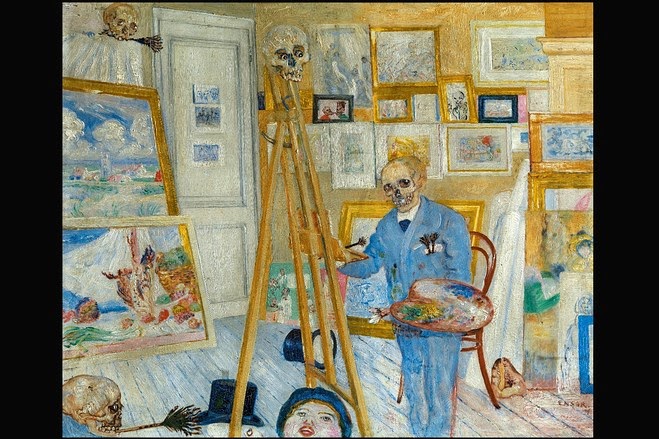
In the early Seventies when I lived in New York I bought a litho of a creepy painting titled "Masks Fighting For The Body of a Hanged Man" by an artist named James Ensor. Pictured above, it's an illustrations of two skeleton women literally fighting it out with brooms and mops over a hanged man with groups of masked freaks and witches looking on from a doorway. It was unlike anything I had ever seen, and it was my entryway into the art of James Ensor.

James Ensor, born in Belgium and creative during the turn of the century , may be one of the most under documented artists ever known. His artwork is an endlessly creative line of grotesque images rendered in a naive art style that can truly elude any easy classification. Sometimes impressionistic, other times expressionistic, yet neither, perhaps his inability to be classified explains his regrettable obscurity after all these years, almost 100 years after his death.

All this "regrettable obscurity" came to a close one afternoon this summer when I drove down Pico Boulevard and saw huge banners of Ensor art hanging from street lamps announcing The Getty Center exhibiting a show called "The Scandalous Art of James Ensor" (June 10-September 7). I could hardly believe my bloodshot eyes!

The Getty Center show is truly a feast to the eyes of any Ensor fan, providing an absolutely comprehensive retrospective this side of Brussels of the great artist's works. I also learned a lot about the great man himself, and was surprised by what I learned. Mr. Ensor may have been The Original Goth Kid. A portrait of his maternal grandmother informs us that she was a seller of grotesque masks which excited and influenced his art in the years to come.

He was also a big fan of Edgar Allen Poe's works and his paintings based on several of his stories, i.e. Hop Frog, including the bizarre "King Pest" were on display at the Getty. He also had a cool harmonium (Nico's keyboard of choice) in his studio that he enjoyed playing. This dude was Goth before Goth got cool!

For all the horror business Ensor served up I don't think it was all gloom and doom. I detected notes of humor in many of his works, and his depiction of government and military officials were reminiscent of George Grosz in the cartoonishness (Ensor predated Grosz so it's presumptuous to say he was an influence on the German expressionist). The subject of death breached a cross between humor and horror, and I liked the party and horror mask paintings the most.

Ensor's wild masterpiece "The Entry of Christ Into Brussels" (1888) was not only displayed in its full splendor but also had a little magnifying glass-style display you could peruse all the details of this unique masterwork. Ensor's mixture of colors and even brush strokes were so erratic which left disturbing hints of a runaway psyche on every piece displayed.

I was happy to see so many people analyzing and enjoying Ensor's works - attendance was pretty robust for such an obscure art star. I also chuckled when I saw an endless line of Ensor souvenirs on sale at the sale counter. I wasn't ready for an Ensor coffee mug, but I got a few magnets and punk rock-style buttons. Now maybe Taschen can put their Ensor retrospective back in print!