Saturday, June 8, 2013

Going Downtown With Carter Brown

There has never been a beast so strange as the paperback publishing world, a once inexplicable planet where writers could make a fortune without garnering much respect in literary circles. I'm not referring to modern potboiler stars like Stephanie Meyer or Robert Ludlum. I'm referring to someone like Harold Robbins, who pretty much in his time had a stranglehold on the bestseller charts with tomes like "The Carpetbaggers" and "The Dream Merchants".

His books have sold in the billions worldwide. When people talk about great crime writers the usual names crop up: Raymond Chandler, James M. Cain, Donald Westlake, Elmore Leonard. Few ever mention or even care about Carter Brown, who in his time (1962-1972) sold millions of paperbacks worldwide. Who is Carter Brown?

Carter Brown in actuality was an Englishman whose real name was Alan Geoffrey Yates. Originally a PR writer for Qunatas Airlines in Australia, Yates turned to writing pulp fiction westerns, sci-fi space operas, and even romance weepies novels under assumed names. Every Carter Brown crime novel took place in America, and it has been rumored that a ton of them were written before Yates even set foot in the States!

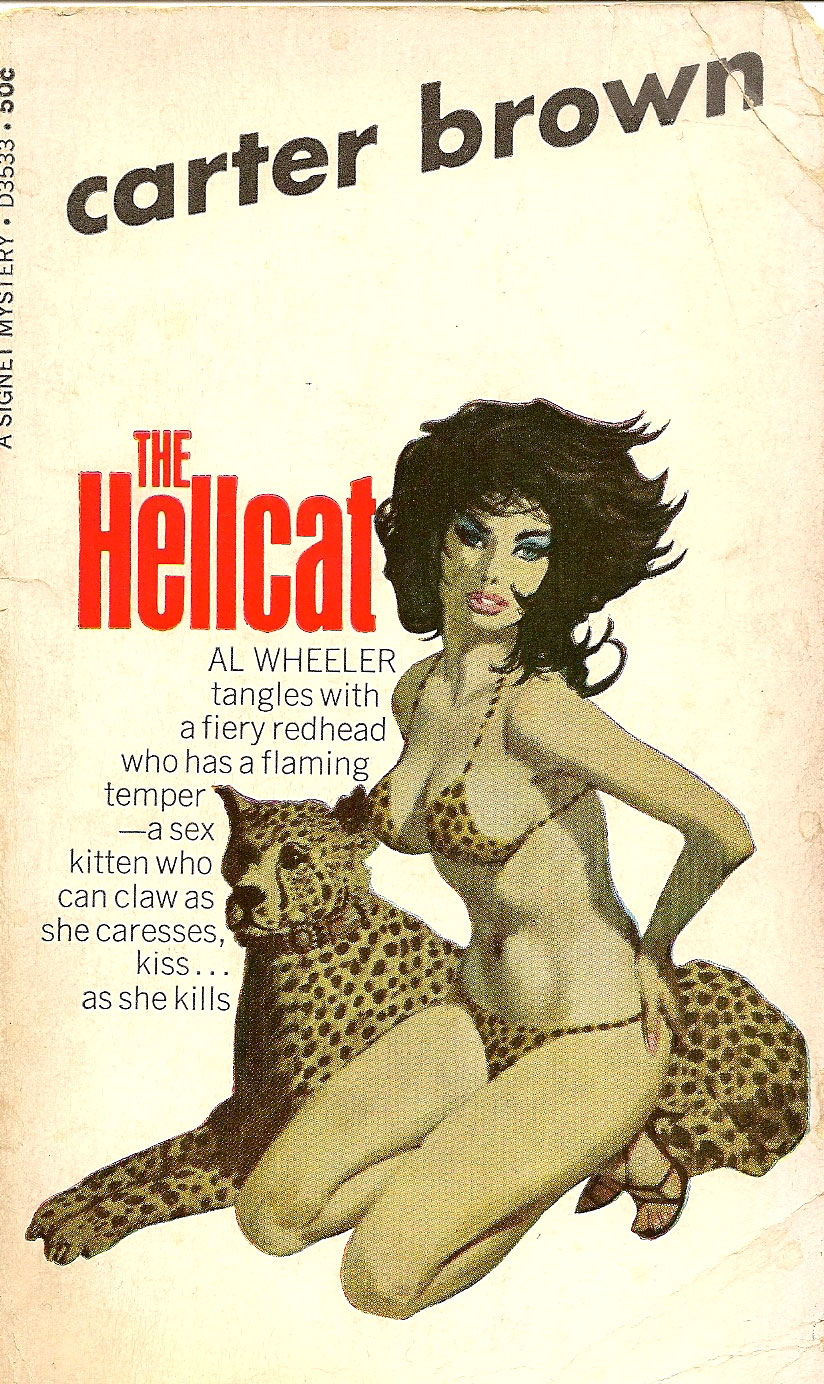
The three most popular recurring characters in Brown's novels are Police Lieutenant Al Wheeler, private eyes Rick Holman, and dumb bunny detective Mavis Seidlitz (with the 38-24-36 measurements). Whichever character Brown featured in his novels you were always guaranteed a lot of smoking, drinking, and sexing up. In other words, Carter Brown novels were cheap Swinging Sixties pulp fiction at their sleaziest. Just to amp up the sleazy sex factor, each brief paperback clocking in at usually 120 pages a piece all featured covers of skimpily clad goddesses by the great Robert McGinnis.

For those who dig the Peter Gunn, Johnny Staccato and 77 Sunset Strip TV shows, Carter Brown is more of the same. Hard lovin' swingin' and two-fisting private eye with killer dames who drop their drawers before they swing their fully loaded .357 Magnum at yr. skull. Smoke a Lucky Strike and crack open a Carter Brown novel, it ain't noir, it's better than noir, it's sexy trash.

While I haven't read enough Brown books to qualify as an expert on his work, I'd like to weigh in on some of my favorite books I've read by him:

The Corpse: Lt. Al Wheeler’s on the case of the mystery of the annoying, drugged-out hepcat that got iced in front of the bandstand at the hippest beatnik jazz coffee house. The only reason his murder’s a big whoop is because he’s the son of a powerful newspaper magnate. The Fifties jazz club vibe of the book will remind you of John Cassavetes’ terrific detective show, “Johnny Staccato”. Lots of babes, booze, billionaires and beatnik bongos abound. The Robert McGinnis cover doesn’t disappoint either.

W.H.O.R.E.: One of the more surreal detective novels ever written, police Lt. Al Wheeler runs afoul of a gang of psychotic killers in Mickey Mouse and Donald Duck masks. The Mickey and Donald-mask wearers are strike breakers who plan on assassinating a Cesar Chavez-style protest leader who's making plans on marching down the Grapevine with his fellow fruit pickers. And that's just the first sixteen pages!

Somewhere in the mix, of course, are a team of deranged feminists called W.H.O.R.E. If it sounds crazy, just remember this was published in 1971 when exploitation films like "Sweet Sugar" and "The Mini-Skirt Mob" were at their apex. Unless Carter Brown's estate is controlled by an iron fist there's no reason why his wild novels aren't being reissued by Stark House or Hard Case Crime.

Tomorrow Is Murder: More Sixties sleaze from Carter Brown about a sexy psychic predicting a millionaire’s death on a Joe Pyne-style TV talk show. The PI this time is Mavis Seidlitz, a bodaciously stacked bimbo blonde in the Little Annie Fanny tradition. She’s on the case in groovy Venice circa 1960, busting up bongo beatnik coffeehouses and catfighting witches into Beverly Hills poolsides. Carter Brown never disappoints.

The White Bikini: Quick, entertaining sleaze about a Hollywood party girl found dead on the beach who may be the daughter of a high-powered movie studio executive. The trail to murder leads private eye Rick Holman to oversexed folk singers in coffeehouses of Venice, psychotic bodybuilders in Muscle Beach, and studio brats spinning roulette wheels in Las Vegas. Trashy good fun that embraces Sixties culture at its wildest.

Other Carter Brown book titles you may not have heard of: Who Killed Dr. Sex?, No Tears From The Widow, The Flagellator, The Ice Cold Nude, No Blonde Is An Island, Nymph To The Slaughter, The Bump And Grind Murders, Walk Softly Witch, and countless more!

Without belaboring the point that Carter Brown novels are sleazy but entertaining trash, there are no philosophical soliloquies that you get in a David Goodis classic or some deep existential journey into darkness like Jim Thompson. Like his contemporary Mickey Spillane, Carter Brown served up pure entertainment dressed up as a sexy crime novel with insanely generous servings of pop culture trash: surfing, beatniks, hippies, strippers, health food freaks, fitness and yoga clinics, pill - popping psychiatrists with nothing but sex on their minds, etc. Compared to the crimes committed on shows like "Breaking Bad" it just seems quaint in comparison.

Saturday, June 1, 2013

MC5 Or DC5?

If there is a more burning question than "Boxers Or Briefs?" it's the big musical question: MC5 or DC5? Not that its impossible to enjoy the music of both bands, but there is a slight generational difference. In some ways they're surprisingly similar - both bands have an affinity blues/jazz only presented differently, and both are also extraordinarily LOUD, especially for their time. Let's weigh both bands:

The MC5 (Motor City Five) were the pride of Detroit, Michigan in 1968 and well initially well-known for aligning themselves with John Sinclair's White Panthers Party, not quite as menacing as the Black Panthers, but still a great gimmick, forerunners to The New York Dolls and their red leather drag and Communist flag shtick and many others following that.

In 1969 several labels hit pay dirt cashing in on the Detroit sound, like The Bob Seger System, The Frost, The Amboy Dukes, SRC, The Stooges, Grand Funk Railroad with even Alice Cooper stopping by for an extended residency. Elektra Records signed the MC5 for the terminally loud 'n proud "Kick Out The Jams" showing the band ripping it up with bottomless American flags rolling down miles and miles behind them.

One of the brilliant highlights of Kick Out The Jams was the choice of covering Sun Ra and The Troggs on the same record, pretty audacious for its time and a definite influence on me, as well. If free jazz can't be played on electric guitars then it can't be played on anything, dammit! Wayne Kramer and Fred "Sonic" Smith clearly defined the band's sound with their wild, barley controlled screaming guitars.

Back In The USA was considered a disappointment when it was released, but I think after the utter Mad House riot Revolution In The Streets vibe of the first album a more controlled affair was in order, so you got more poppier songs like Shakin' Street and High School. By the time High Time was released the band was back in full psycho abandon with tracks like Sister Anne, Sonically Speaking - back to the jazz saxes honking like mad - and Future Now.

I'm the usually the last to hear good news about anything, so I just recently heard that in 2010 Dave Clark finally turned over at least ten albums worth of material of DC5 (Dave Clark Five) music, three of them containing either unreleased or obscure tracks that barely got its minimum daily requirement of oxygen. Unfortunately they're only available on iTunes, so it's time to pay the Apple piper again. But I digress.

The DC5 were such a powerful force during the British Invasion that they knocked The Beatles out of the Number One position in the charts and in their prime were two steps behind The Fab Four everywhere they went. They followed The Beatles as the second English band to play on The Ed Sullivan Show. It was that serious, but why not? They were sensational.

Unlike the MC5 there was more than guitar army reconnaissance going on: the DC5 had some wicked blues organ playing from singer Mike Smith, who wrote most of the material, and wicked raspy saxophone playing from Denny Payton. Denny Payton occasionally overdubbed his tenor and baritone saxophones together on several songs, sounding not unlike that badass Dana Colley from Morphine.

With Mike Smith's snarling vocals mixing with Dave Clark's military march pounding (pre-dating Gary Glitter's homo stomp by a good 10 years!) and Payton's growling mad dog saxophone, the DC5 tore into R&B standards like "Do You Love Me", "Reelin' and Rockin'" and "I Like It Like That" with vicious abandon.

Equally exciting is the new, unreleased material like "Fallout Shelter", "The Man In The Pin Stripe Suit", and "Return My Love". And how great is it that we can finally enjoy songs like "I'm Thinkin'" and "Say You Want Me" in digital panorama sound instead of that scratchy Epic Records vinyl. Nostalgia is nice but pops and hisses aren't and a good, clean polish only makes the songs sound more demented.

The influence of both bands is far and wide, almost hard to even estimate: MC5 have influenced bands like Radio Birdman, KISS (esp. High Time, listen to Baby Won't You or Over And Over) and The Didjits. The DC5 have clearly influenced bands as varied as The Monks, Slade - check out the stomping drums! and The Ramones, who covered the sublime Any Way You Want It.

If you haven't heard the MC5 lately dust off their records and turn it up, especially Sister Anne. And if you haven't checked out the DC5 on mp3, now's the time to do it before Dave Clark pulls a Walt Disney and pulls the tracks off the shelf, which he's done before. I guarantee it'll clean your clock!

Saturday, May 25, 2013

Full Time Killer (China, 2001)

Full Time Killer is a brilliant crime film that starts at a kinetic-cum-frenetic pace and maintains its breakneck tempo all through the movie. Directed by Johnnie To and Ka-Fai Wei, it's one of the most exciting suspense films I've seen. Full Time Killer is the story of two hit men, Ono (Takashi Sorimachi), a Japanese: quiet, expedient and efficient like a ninja, while the other, Tok (Andy Lau), a Chinese, is loud, sloppy, and showy in his leather rock star outfits, completing his kills by throwing his arms up in the air like Neil Diamond after a big concert. Needless to say, Tok is a movie buff and loves spectacles. Tok is told over and over again by his boss Ice that Ono is the greatest hit man in the East, far superior to Tok, sending him on a rampage to upstage his Japanese superior. What results is a series of assassination upstaging between the two that recalls Spy Vs. Spy comics at its most devious.

The film opens with Ono performing a hit at a Malaysian train station, almost cock-clocked or I should say, kill-blocked by an old school chum. Ono executes his hit and then, in a fit of pique, shoots down his classmate, alerting Interpol policemen of his crime.

While Ono is out killing people in public places his cleaning girl, Chin (Kelly Lin), moonlights as a clerk in a Japanese video store (in Hong Kong). Tok,a regular at the store asks Chin out for a date in Bill Clinton mask, his tribute to the surfing criminals in "Point Break". His keeps his Clinton mask on when they go out to the movies. She takes a liking to him even though her heart belongs to Ono, thus creating a weird romantic triangle that recalls "Jules & Jim" or "Butch Cassidy & The Sundance Kid" in a perverse way.

Tok's dance card is pretty busy, teaching Chin how to hit a target from a high-powered rifle and then executing a hit in the middle of downtown Hong Kong (looking a lot like 6th & Flower by the Bonaventure Hotel in LA). Ono takes pictures of the hit from a balcony in the distance and faxes them to Interpol agent Lee (Simon Yam), who's heading the hit man crackdown. It's interesting how many hits occur either in train stations or around vehicles, establishing the effect of death amidst constant motion, like lions in Africa pursuing a herd for a kill.

Ono's hit in Singapore is completely expected by his victim with him realizing that his manager must have sold him out by informing them of his attempt. To make matters worse, Tok is shooting from a balcony nearby at Ono, trying to kill him. This scene recalls countless western films, and in fact creates a cowboy movie shootout vibe all through the picture.

Now that Ono's cover is completely blown his apartment gets busted into while Chin's cleaning up, recalling the way his last cleaning girl was murdered, only this time Ono comes to the rescue. With both the organization and Interpol both nipping at his heels Ono and Chin need to escape from Hong Kong and vanish from everyone.

After watching his entire squad killed by the two hit man in a hail of bullets, Agent Lee suffers a nervous breakdown and leaves the force, drowning in a sea of depression and Chinese beer. He takes a break from drinking to write a book about his Ono and Tok manhunt and how they both got away, but in his words, "There's no book without an ending".

Lee gets a phone call from Chin, giving him the ending he needs for his book. She related the story of her escape with Ono, who finally confesses what he did for a living (or should we say a killing?). She then talks of one night in a bar where Tok joins them at the table, buying them drinks and telling Ono they're going to play a game a called Metal Slug to the death.

Ono accepts and the two have a final showdown in a Chinese fireworks warehouse, giving us a brilliant climax to an already exciting film. Chin gives Lee an ending to his book and then disappears into the night, letting us know that one hit man died and the other lives on, but which one is it? You'll just have to see Full Time Killer to find out.

Everyone in the film gives a perfect performance, Lau terrific as the arrogant showman and Sorimachi just as awesome as the stoic killer. Only Lin's performance is a little wobbly as the girl torn between two killers. You can pretty much tell who she likes more and doesn't really have us fooled. Yam is also excellent as the police chief gone over the edge without resorting to cartoon hysterics. Full Time Killer never feels cartoony and in fact serves up some of the best cowboy gunfights and shoot-em-ups ever filmed.

Saturday, May 11, 2013

5 Tops 100 Hours


The next time you see somebody on "Project Runway" look like they shit a cow after being told to create an outfit in 24 hours, slap them silly for me. I created five tops in 100 hours, and if I were to compute the time spent actually sewing them it would be a mere fraction of that time. Since Rebecca was out on location for the next four days I had unlimited access to the workshop and all the equipment to make the clothes I love to wear, and I did just that. Let's go through each top, one by one:

On Day 1 (Tuesday) I sewed a top made of some stretchy green fabric I bought from the remnant rack at Michael Levine's. It was absolutely hip, exciting and beautiful to work with and look at, but there was only enough to fabricate a shell with. Since there wasn't enough material to make sleeves I had to employ something else so I used some great fishnet material to finish the job. I always like making tops with fishnet sleeves so I can show off my 7-star tat sleeve (go to Purple Panther Tattoo), so I tricked out some fishnet arms and I'm very pleased with the results. How's that for hip, exciting and beautiful?

Day 2 (Wednesday) had me making a purple velvet top. This was a challenge, to be sure, because it wasn't crushed velvet and there almost wasn't enough material to finish the job. In fact, one of the arms had to be cut in two segments in order to complete the top - a sleeve is usually cut in one piece. Ironically, it was the two-piece sleeve that had better ease than the one-piece sleeve! This piece was so tight I'm going to have to cut out pasta and ice cream for the next five years.

On Day 3 (Thursday) I made a tank top of bamboo material. Since I already own several pieces made from bamboo I was excited to work with this material. Bamboo has a texture that feels like cotton but has a coolness to it that feels more like a poly blend. In fact there were times when I felt like I was working with a lycra/polyester combination, so unfibrous was the material.

Making the tank top was a challenge because bamboo is very delicate, sometimes too much so. On three occasions the material got caught in the fangs of the feed dogs of the sewing machine (between the bobbin and the walking foot), the last time being the worst. The fangs took a big bite out of the material and I had to pull the material out leaving a nice rip in the fabric before I could even finish the job. Nuts!

Day 4 (Friday): Equally sensitive was the purple bamboo I purchased on closeout at Mood for only $3.oo (what a find!). This tore quicker than TP and three bad turns with the scissors required some quick repairs. I do not recommend this material for sewers with serious patience issues or quick tempers. God knows I lost mine after the second time I accidentally cut through the fabric. The top turned out okay but more than slightly looks like the walking wounded!

There was supposed to be a fifth top, a black crushed velvet stretchy thing, but I wasted most of the day constructing a muslin that turned out worse than the actual top itself. Although it's procedure to make a muslin practice run I made so many revisions that it took up most of the day. Nuts!

Truth be told, making cool clothes in a limited amount of time felt more like "24 Hour Catwalk", the short-lived show hosted by Alexa Chung and an uber-bizarre group of sewing professionals, all veterans of the fashion industry, especially tough muffin JustRaymona. I wish I had JustRaymona helping me with these delicate fabric nightmares. Time is tight.

Friday, May 3, 2013

Alec Empire's Empirical Revolution

One of the most exciting artists in music today, Alec Empire has been recording and producing music for over twenty years, and is still more contemporary and alive than most music being produced today. An Alec Empire record could be electronic, it could be punk rock, or it could even be very ambient in the Brian Eno mode. One thing's for sure, Empire is one of the most unpredictable (read: uncategorizeable) artists in music.

My introduction to Alec Empire's brand of sonic skronk came not from his popular band Atari Teenage Riot, but from a wild compilation series of electronic noise, "Electric Ladyland" (no connection to the Jimi Hendrix album). Tracks like "Caucasian Death Mask" and "Naive Fake Jazz" as well as his brain scraping collaborations with New York band Techno Animal got my attention. All this and more guaranteed groove based musique concrete and ear blasting dubstep workouts.

Seeing the name Alec Empire over and over again provoked further investigation into this character and finding out that he also made some insane rock records, like "The Golden Foretaste of Heaven" which features the great "New Man" which sounds like Gary Numan with deranged Iggy Pop vocals (currently on my jukebox to the right) and "If You Live Or Die". There's still lots of great electronics, more of a rock action beat going on, with Empire crooning nihilistically all over the mess.

"Futurist" is a more punk album, giving substance to his Digital Hardcore manifesto. His brand of Digital Hardcore is way more punk than Ministry or Nine Inch Nails. The hardest tracks are "Gotta Get Out" and "Overdose" with his screaming and synth screeching ripping your skull clear off your neck in 3/4's of a second! A completely different release is "Shivers", more groove/dance oriented with the standout track being "Baby Skulls", a cold hard look at the fascist attitude of the United States Government and its overbearing and invasive foreign policy, dressed up as peace and freedom loving. In a pig's eye.

After all this Empire worship I finally decided to go back and listen to his main project Atari Teenage Riot, and while I still find some of the punkism a little too Hot Topic I still think it's more admirable that the band play at Anti-Nazi rallies and every so often the band bust out a wild jam like "Revolution Action".

If you don't know who Alec Empire is I strongly urge you track his stuff down - he's definitely not hiding in a cave, he's out and about on Tumblr, You Tube, Twitter, Facebook and other digital watering holes for your review. The guy's not too shy about switching styles so there's something for everybody to enjoy from him, and if you don't try I'm going to get in your face about Amon Tobin, Kid Koala and DJ Spooky.

++++++++++++++++++++++

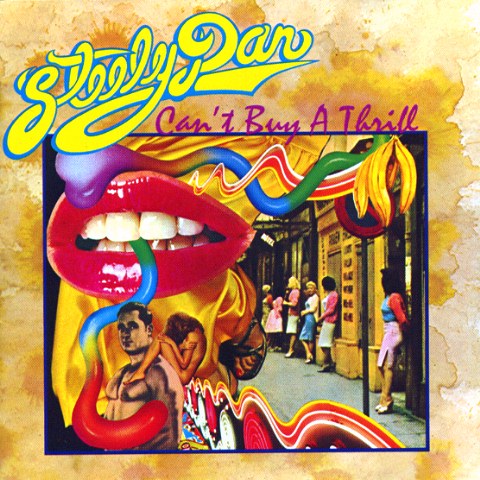
When I think of the Seventies and all the darkness I went through following the loss of my parents which introduced me to my teenage years, two songs haunt me even to this day: Blue Oyster Cult's "Don't Fear The Reaper" and Steely Dan's "Do It Again". Both songs appeared as if bookends during different sides of that decade, "Reaper" in 1976 (pre-punk) and Steely Dan in 1972 (pre-glitter). This is no coincidence as both songs almost seem to be waiting for those two powerhouse trends to finally manifest and bring on the fun, but until then...we have these two brilliant but sad songs to fill in the pleasure void.

BOC was ahead of their time with the "Agents of Fortune" album, forerunners not only of punk but of goth music as well. Dark themes of ghostly apparitions (The Revenge of Vera Gemini), S&M (Dominance and Submission), black magic and even Joan Crawford were explored by the band and it was a lot less broad than Black Sabbath's take on darkness.

Steely Dan were just plain weird and conjure up so many memories of teenage years going to West Hollywood and meeting hustlers, mentally disturbed teen runaways and trannies - Ricky Don't Lose That Number, indeed - at Arthur J's and The Other Side aka OS and seeing The Deadly China Doll perform. The haunting sounds of "Do It Again" conjures up a sleaze stew equal parts Jean Genet and William Wellman's "Wild Boys On The Road". Sex was still scary and homosexuality was even scarier, naked men with awful sideburns and hairy bodies! Steely Dan captured that cocaine meets that Locker Room butyl nitrate stench down Santa Monica Boulevard groove with "Do It Again", the tale of a loser who dabbles with the seven deadly sins, Drug Addiction, Alcoholism ("you'll be on your knees tomorrow"), Murder, Gambling ("you must put your cards on the table") and the whole damn thing.

With all the talk about the wheel turning round and round and a sitar solo you know there's a Hindu higher power beckoning from behind the curtain, evidence in their rockabilly jazz classic "Bodhisattva". Just think, The New York Dolls were also waiting in the wings to make life fun again. It's all too much!