Wednesday, July 11, 2012

Kontroll (Hungary, 2003)

“Kontroll”, directed by first-time Hungarian director Nimrod Antal, is one of the most exciting films made in the past ten years. Equal parts suspense film, surreal mystery story, horror movie and even comedic satire, it is a breathtaking work of exhilarating beauty. Filmed in the Budapest subway system in 2003, Kontroll is one of those films that never leaves the indoor environs of the subway station and never gets boring, a pretty amazing accomplishment.

Kontroll is the story of a burnout named Bulcsu (Sandor Csanyi), a ticket inspector for the subway system who not only works in the subterranean station but lives and sleeps there, as well. Regarding the city above him with agoraphobic horror, he's shown lumbering around the subway station like a 21st Century Caveman and always appears to be in some form of bloody dishevelment. He’s the leader of his team of ticket inspectors, pretty funny stuff in that these teams behave more like street gangs than subway authorities.

Bulcsu’s biggest rival is another inspector named Gonzo (Balazs Mihalyi), who challenges our hero to a unique game of chicken called “railing”, where they race each other down the subway tunnel with the non-stop Midnight Express racing behind them. Whoever reaches the arrival platform first wins the race. Antal films the railing scene brilliantly, suspense building with every shot.

Another matter is a mysterious hooded killer who leaps from the shadows and pushes riders off the platform to their death by subway train. After every murder the transit authorities show up, led by a cold-blooded executive (Gyorgy Cserhalmi) who looks creepier and more menacing than any of the inspectors. Could he be the killer?

Kontroll never gets boring because there’s always something weird going on: a narcoleptic inspector who passes out whenever he gets confrontational, Bulcsu’s team chasing after Bootsie the Vandal, a psych called in to examine the nutty inspectors, and a dark, creepy rave party where Bulcsu pursues the subway killer.

Subway operator Bela (Lajos Kovacs) is also a burnout, and like Bulcsu spends his many hours eating and hanging out in his train with his daughter, Szofi (Eszter Balla). Szofi is every bit as nutty as Bulcsu and her dad, riding the rails in a huge teddy bear costume, and later in the film fighting off a team of inspectors in her bulky outfit.

After facing accusations of being The Subway Killer, Bulcsu, fed up, quits his job and finds redemption by allowing Szofi, no longer dressed as a teddy bear, but as a guardian angel, to escort him back up to the Big City and face the reality he had been hiding from down below.

Bulcsu is probably the coolest scuzz in movies, looking like a cross between Mickey Rourke from “Barfly” and a Brendan Fraser from Hell. Even when he appears impassive to what’s going on around him you’re curious as to what’s really cooking around in his head.

Nimrod Antal’s excellent direction is complimented by Gyula Pados’ ingeniously framed cinematography - check out how many times he makes the tunnel look like spider webs - and bordered by a visceral soundtrack by Neo. Kontroll was the first Hungarian film to show at the Cannes Film Festival in 20 years and won the coveted Le Prix De La Jeunesse award. It also won the Best Foreign Language Film Award at the 2004 Chicago International Film Festival.

While there are a few inevitable plot holes in the movie, Kontroll is one of the most exciting and visceral films you’ll ever see, a dazzling thing of speed and beauty and I highly recommend it.

++++++++++++++++++++++++++++++

Old sex symbols never die, they just end up making lurid erotic horror films in Europe. Sue Lyon created a scandal playing the title role in “Lolita”, later reprising the sexy nymphet role in “Night Of The Iguana”, but by the Seventies all the sexy steam ran out and she went to Spain in 1973 to film the awful “Clockwork Terror”.

Carroll Baker faced a similar dilemma by following up her scandalous debut in “Baby Doll” with movies like "Sylvia", eventually going to Europe to star in “Baba Yaga”, an adaptation of the Guido Crepax comic “Valentina”, where Baker plays some weird old witch. While it’s somewhat better and more interesting than “Clockwork Terror”, “Baba Yaga” comes off as a sort of low-budget “Blow Up” with all sorts of occult hijinx to keep you from falling asleep.

Wednesday, July 4, 2012

Rock & Roll Confidential Part 10

It was the 4th of July 1976, the 200th anniversary of Independence Day in the United States. Although everyone threw parties and I resisted an offer to drop acid and watch fireworks, I held my ground to celebrate in the quietest way possible. Who was I kidding? I went that night to The Starwood to see Jr. Walker and The All-Stars.

The Starwood was in West Hollywood on the corner of Santa Monica and Crescent Heights Boulevard, was formerly know as PJ’s in the Sixties, and was later owned by Eddie Nash of The Wonderland Murders notoriety. It was an enormous club of disco proportions, which is to say there were many grottos to do drugs in, a dance room where Rodney Bingenheimer spun records and a huge concert room with a balcony.

It was a pretty strange night, don’t ask me why. I was one of the few white kids in the club, and actually, the club wasn’t too packed. The club goers that night, on average were black couples in their late thirties to early forties dressed in their Sunday best. Suits with ties, the gals in their classiest dresses festooned in even classier jewelry, very elegant when they hit the dance floor looking oh-so serious to Jr. Walker pounding out the hits – “Shake And Fingerpop”, “I’m A Roadrunner”, “What Does It Take (To Win Your Love)”, and the immortal “Shotgun”. It was easily the most offbeat audience I’ve ever seen rockin’ out in all my years of nightclubbing. (Second place goes to a lot of grim, handicapped lesbians at a Patti Smith show in 1975).

Jr. Walker and The All-Stars had the most diamond-hard piercing sound I’ve heard, the guitarist peeling out riffs effortlessly while the organist hit grooves like a well-oiled machine, all topped by Junior Walker’s ear-splitting saxophone playing. As soon as I got home I pulled out my horn and started honking like a silver-plated demon. Memories are made of these.

++++++++++++++++++++++++

Another summer night at The Starwood was even weirder, if possible. In 1974, my friend Chuck and I decided to go there on a boring Saturday night to get drunk and hopefully laid. As long as we got connected we didn’t even care who was playing that night. Well, it turned out to be Tim Buckley, and he was no longer strumming an acoustic guitar.

The only previous exposure I had of Buckley was his appearance on The Monkees performing “Song To The Siren” and a mellow track on the Straight Records compilation “Zapped” titled “I Must Have Been Blind”. When I saw his name on the Starwood marquee I feared beat folkie Troubadour acousticness. How could I be so wrong?

Buckley had an electric band backing him and they played a powerful groove that went on and on, songs with sexy lyrics like “Get On Top”, “Move With Me”, and “Sweet Surrender”, every once in a while yodeling like Leon Thomas’ electric bastard son. It was pretty overwhelming stuff, and while it didn’t make me run home and break open the sax it was still a night to remember. And I didn’t get high or laid that night, either.

+++++++++++++++++++++++

I recently watched an epsiode of "Classic Albums" on VH1-Classic and the album being profiled was Black Sabbath's "Paranoid". One of the weirdest tidbits was the admission that "Fairies Wear Boots" was about skinheads and how they used to bully the band in their neighborhood. Can you imagine these fucking thugs being immortalized by Ozzy as being a bunch of fairies? That's pretty funny and harsh at the same time.

Another show I watched on the same station was a sketchy documentary on Lemmy which almost avoided playing Motorhead music. Outside of "Ace Of Spades" and "No Voices In The Sky" and another track from "1916", it was mostly Mr. Kilmeister playing rockabilly covers(?). I don't even think there was any mention of The Rockin' Vicars, his work on Stiff Records or his legendary days in Hawkwind. Pretty weak!

Thursday, June 14, 2012

Sheitan (France, 2006)

Trashy, nutty and absolutely demented, “Sheitan” is one of those films that’ll leave you scratching your head wondering what the hell you just watched for the past 90-plus minutes. Sure, it’s a horror film, but one that treats Christmas Eve as a satanic ritual. It’s that twisted!

“Sheitan” begins with a clique of hip-hop club kids led by the annoying Bart (Olivier Barthelemy), a rowdy punk who tears shit up who basically gets his French ass handed to him all through the movie. He meets a comely nymphet, the mysterious Eve (a terrific Roxane Mesquida), and since he doesn’t have any wheels, persuades his pals to take them to her home so he can bang her silly. Here’s where the trouble starts.

The clique is a veritable United Nations of teenage immigrant punks, one from every continent, i.e. an Asian pal named Thai, an African guy (Ladj), and his date for the night, a cool Perisan girl named Yasmine, all out for sex and thrills.

Eve lives on a farm in the middle of Nowheresville, France, where they meet her uncle, Joseph, a creepy farmer played with lip-smacking relish by Vincent Cassel, much better here than in the turgid “Black Swan”. Joseph, looking like some demented Jethro Tull roadie, is all smiles, charm and racist remarks about the visiting ethnic teenagers. Before anyone can call him on his nasty remarks he treats everyone to a squirt of milk from an overly pregnant goat. The only taker is Eve, who happily gets on her knees and takes a fresh goat titty squirt of milk in her mouth.

Joseph takes an exceptional interest in Bart, even going so far as introducing him to his slutty niece Jeanne (Julie-Marie Parmentier), who looks like she’d go down on anything that moves. Actually she does a plum scene where she jacks off a big black dog. All the farm kids look inbred and deformed, with two boys in particular who resent the attention paid to Bart and his pals. All sorts of weird pranks are played on them, including a bed-ful of crickets and cockroaches.

Raising the blasphemy level ever higher is the fact that this all takes place on Christmas Eve, with the plan being that Joseph’s wife/sister Mary will be giving birth that night to a young Satanic king. Cassel plays a great French Satanist, investing generous amounts of dogma to his passionate speeches about the Devil and his omnipotence.

“Sheitan” is filled with great scenes of debauchery and depravity, one standout scene being a naked battle between Joseph, the urban club kids and the inbred farm kids. What starts out as good clean fun degenerates into raw aggression, with Bart once again getting his face smashed in.

The film reaches its grand climax when the clock strikes midnight turning the night before Christmas into Christmas Day, when Joseph’s wife Mary breaks her water and drops her baby. The baby, as it happens, is a doll with newly installed human eyes, eyes belonging to…guess who?

“Sheitan” will never be accused of being great art, but it’s trashy good fun and far more interesting and twisted than any teenage horror film produced in the past twenty years. Kim Chapiron directed and Vincent Cassel co-produced this dirty little gem, a pretty wild piece of French filmmaking that’s an antidote to junk like “Amelie”. It's also the only horror film about Christmas worth a damn, for whatever that's worth.

++++++++++++++++++++++++++++++++++

I recently saw Gregg Araki’s 1995 film “The Doom Generation”, a combination of Jean-Luc Godard nouvelle vague and Richard Kern erotic psychomania. The Godard influence can be seen in the first half with his patented hipster frolicking of “Band Of Outsiders” and “Pierrot Le Fou”, even down to naming his three main characters Red, White and Blue. The Richard Kern influence begins with Rose McGowan pinch-hitting for Lydia Lunch by playing the cunty vamp, culminating into a full-on, explosive Cinema Of Transgression finale, where a gang of jocks brutally assault Red, White and Blue while reciting “The Pledge of Allegiance”. Pretentious as hell but still worth a view. Outside of “Mysterious Skin” I don’t think Araki’s made anything else of substance -Smiley Face, Nowhere, Kaboom are just plain awful- but at least he knows how to grab your attention.

Thursday, June 7, 2012

Pret-A-Poseur

Clothes might make the man (or woman), but selling them in editorials make the clothes more exciting for all of us. An editorial can be an amazing collaboration between a magazine’s art director, the photographer, and even the models themselves. Three recent shoots really made a big impression on me, and they’ve also made quite a splash in the fashion world, too.

Oyster Magazine recently published a terrific photo shoot by Benny Horne starring Tati Cotliar modeling Prada, Derek Lam and others playing a hysterical 1964 Beatles-English Invasion fan. The shoot, titled “Baby It’s You” is wild, stylish and very funny. Benny Horne’s photography brilliantly recaptures images of the British Invasion and their hysterical fans with dazzling accuracy. I also detected some badass Weegee flash photography action in many of these shots.

On a personal note, I think it’s pretty awesome Tati was born on my 34th birthday (October 31, 1990).

Stav Strashko (last week’s blog cover boy) is in the Andrej Pejic tribe of androgynous models, meaning he does quite a bit of drag. One of his most infamous photos showed him dressed as a French maid on his knees doing a bit of dusting with a cig dangling impudently from his lips. Very drag badass.

In this group of pictures he’s modeling some cool rock wear and probably some ladies wear, too, and styled to look like an elegantly wasted rock star, down and out in the streets of Paris and London. Just like the Tati photo shoot we’re seeing some great vintage rock imagery showcasing some brilliant new fashions.

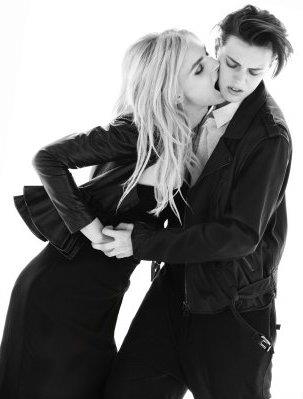
One of the most controversial and outrageous photo shoots in recent memory is the “Battle of The Sexes” for Forward by Elyse Walker shoot featuring Andre Pejic as the abused girlfriend and Erika Linder as the abusive boyfriend.

Photographed by Sara Saric in Robert Longo style, this would be a fairly offensive editorial were it not the fact that both parties are absolutely brilliant in their gender-reversed roles.

Fashions worn by Ms. Pejic are from designers as diverse as Proenza Schoeler, Stella McCartney, Lanvin, among others. Erika’s modeling Givenchy and Rick Owens.

If there is one thing these models all have in common, it's style, and style is the invisible cosmetic they wear that captures our imagination. Bottom line, whether fashionistas run out to buy these designs or not doesn’t matter because once again, the sizzle’s usually a lot better than the steak. Presentation is everything, and the audacity of these rock-inspired images make an enormous impression that lasts.

Wednesday, May 16, 2012

I've Got Friends: The Sunset Of Celso Chavez

On May 9, 2012, my friend and colleague Rob Zabrecky reported the sad news that Celso Chavez had passed away at 1:42 pm that afternoon from pneumonia due to complications brought on by lyme disease. The news was surprising because of all the musicians I’ve ever played with he was probably the healthiest and most physically fit.

I first met Celso in early 1989 when Lucas McClelland, my bassist, brought him to our rehearsal. Celso picked up the songs right away and brought a great positive attitude to a band of jaded cynics like us. To be perfectly honest I look back on the 1989 edition of Trash Can School with affection and nostalgia. After searching for so many years for players that shared my quest for musical exploration it was a genuine gift to have Celso, Lucas and Manny share my enjoyment in exploring new sounds and sonic landscapes.

Celso was responsible for our most memorable song, a cover of Patti Smith's “Horses”. At one of our rehearsals out of sheer boredom we started playing a feedback-laden version of Frank Sinatra’s “New York, New York”, and instead of crooning the familiar opening line of “Start spreading the news, I’m leaving today”, I went into “Jesus died for somebody’s sins but not mine”. Lucas and Manny followed Celso’s and my lead and, well, the rest is history. In fact, when you hear the opening chords to our recording of “Horses” that’s Celso you’re listening to.

One of his favorite stories he liked to tell was the time we recorded that single at Radio Tokyo. When it was time to record “Phantasm III” I asked him, “Well! Are you ready to lay down your solo?”
“I’m playing the solo? No way”. (Getting nervous)
“Didn’t you prepare a solo?”
“No! What am I gonna play?”
“I don’t know but you’re gonna have to come up with something amazing in about five minutes”.
“Dude, I’m totally scared. I’ve never played a guitar solo before!”
“Perfect, you’ll be great. Take all the fear that’s inside you and pour it out of your guitar”.

Celso recorded his guitar solo in one take, a manic, screaming slice of atonal brain shred sounding like a Latino Sonny Sharrock at his most homicidal. For the rest of his life every time Celso saw me he said, “You told me I was a lead guitarist and I wouldn’t believe you but you made me believe!” His gratitude always touched me because it was genuine, like everything he felt.

In the brief time he was in the band (less than a year) he made a substantial impression on our music as he co-wrote “Baby Lust”, another one of our biggest songs. Celso’s knack for writing and arranging great, catchy rock songs was always fine tuned.

Celso shortly left Trash Can School to play with Possum Dixon, writing and recording “Friends”, a hauntingly brilliant song about the irony of friendship with layers of feedback guitar and an eerie reverbed vocal.

“I’ve got friends who sit around
And laugh each time you walk in the room
With your candy clothes and cigarettes
The way you smile and undress
I’ve got friends…”

© 1990, Apartment Music, BMI

We went our separate ways, but in 2002 I left a comment on the message board for his new band, Pill Module. He called me shortly after and we started meeting for lunch periodically. He was working for the LA Unified School District or a similar non-profit educational agency and I worked for the LA County Department of Children & Family Services. Celso was always happy to see me and fun to talk to, telling me about how proud he was to be a father and how much he loved his wife and son.

During the time I saw him I turned him on to Emmitt Rhodes and David Garza since they both played pop music with an edge, both of whom Celso never heard before. When I told him David Garza was going to play Café Largo soon we almost went, but we both lamed out and flaked.

After another lunchtime I remember taking him to the Jewelry District downtown to my favorite jeweler because he was getting a diamond necklace for his wife, Veronica. I totally hooked him up and he never stopped thanking me for it. Another time I took him down to the LA County Department of Human Resources to check out the clerical positions there because he wanted something that paid better and had better job security. He was pretty serious about keeping his life together. Eventually we drifted apart again; I guess friendship has its irony all the time.

When I think of Celso I remember a man who always maintained a positive attitude, an open mind to new ideas, and a free-spirited willingness to gamble with a crazy bandleader who always went for broke. Although the sun has set for my friend Celso, after the sunset is the coming of the stars in the sky, and the brightest star in the Hollywood sky tonight and every night is Celso Chavez.

Photography by Chris Blum